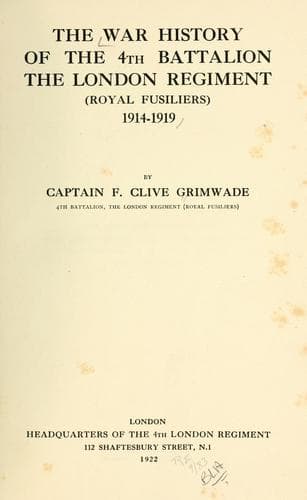
The War History of the 4th Battalion, the London Regiment (Royal Fusiliers), 1914-1919Grimwade, F. Clive
History
The War History of the 4th Battalion, the London Regiment (Royal Fusiliers), 1914-1919
Grimwade, F. Clive
Great Britain. Army. London Regiment. 4th (City of London) Battalion; World War, 1914-1918 -- Regimental histories -- Great Britain
Throughout the 11th and 12th heavy fighting continued in which the
167th Brigade co-operated with the Guards on the left in numerous
efforts to clear out the re-entrant and reach the Ginchy Quadrilateral.
This magnificently defended position, however, held out against the
most gallant attempts of the attackers. During the night of the 11/12th
September the 167th Brigade was also relieved, the line being taken
over by the 16th Brigade of the 6th Division.
The Battalion remained at Billon Farm for three most welcome days of
rest and reorganisation during which the weather, which now once more
became fine and warm, was of inestimable value in cheering the troops
after their somewhat trying experience. The relief to the men's spirits
on emerging even for a short spell from the ghastly featureless waste
of the battle area to surroundings where trees still bore their leaves,
roads still crossed the hillsides, and houses were not completely
effaced, was immense; and by the time the period of rest was over the
Battalion was once more braced up to continue the struggle.
One or two changes occurred during this period among the officers of
the Battalion, of which the most important was the assumption of the
Adjutancy by Lieut. W. J. Boutall on the evacuation to hospital of
Capt. R. L. Herring, who had occupied this trying position practically
since the Battalion joined the 56th Division. 2/Lieut. Garratt assumed
the duties of Assistant Adjutant almost immediately afterwards. Capt.
J. T. Sykes left the Battalion for attachment to the Indian Army, and
the signalling officer, Lieut. E. W. Monk, to join the R.A.F. The
latter's duties were taken over by 2/Lieut. S. J. Barkworth, M.M. In
addition to these 2/Lieut. A. C. Knight was evacuated to hospital.
_The Battle of Flers-Courcelette 15th-18th September_
The renewal of the offensive was not long to be delayed. The object
of the High Command was to follow up the blows delivered against the
German positions as rapidly as possible, and to leave the enemy little
respite for reorganisation and rest. The constant hammering on his
defences had already had an appreciable effect on his morale, and it
was hoped that before long the strain on his resources would prove so
great that the situation would develop rapidly in favour of the Allies.
Public-domain text, read in full here on John Shaqi.
Reviews
Reviews
No reviews yet
Be the first to share your thoughts on this work.
Elsewhere in the archive
Join the Discussion
Join the discussion
Sign in to leave a comment or review.
Sign InorCreate an account