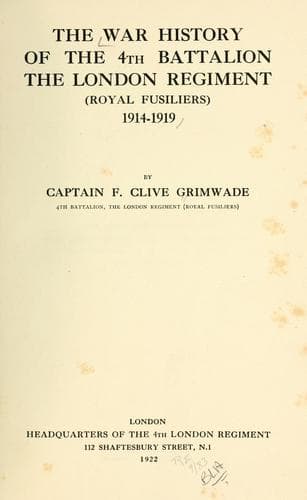
The War History of the 4th Battalion, the London Regiment (Royal Fusiliers), 1914-1919Grimwade, F. Clive
History
The War History of the 4th Battalion, the London Regiment (Royal Fusiliers), 1914-1919
Grimwade, F. Clive
Great Britain. Army. London Regiment. 4th (City of London) Battalion; World War, 1914-1918 -- Regimental histories -- Great Britain
To establish this defensive flank the 169th Brigade on the right was
to push forward of Leuze Wood and occupy a position roughly north
and south with its left flank astride the sunken road from Combles,
about 300 yards east of the edge of Leuze Wood. The 167th was to clear
Bouleaux Wood in two stages and establish a line parallel to and about
100 yards in front of its east edge. The 1/4th Londons were to follow
up the advance of the 167th Brigade and then "leapfrog" through it on
to the German third line immediately in front of Morval whence they
would connect up between the left of the 167th Brigade and the right of
the 6th Division.
The 15th September was on the greater part of the battle front a day
of big successes. At an early hour Flers fell before our assault, and
by the afternoon the British line had been pushed far beyond it; the
whole of High Wood was taken, and before nightfall Martinpuich and
Courcelette on the left had been added to the gains of the day.
On the extreme right, however, the advance suffered a rather severe
check. The Guards, who occupied the left of the Corps front, were able
to make solid advances between Flers and Lesbœufs, but the 6th Division
adjoining them were held up by the Quadrilateral at Ginchy, whose brave
defenders still maintained their position most stubbornly; and this
failure naturally reacted on the 56th Division who occupied a narrow
wedge between the Quadrilateral and the Combles ravine.
At 5.50 a.m. the three tanks which were to make their début with the
Division left their departure points for the first objective, and at
6.20 a.m. the infantry assault was launched. Almost three hours later,
at 9 a.m., the 1/4th Londons left their bivouacs in Angle Wood Valley
and moved forward in artillery formation towards the battle position
on the crest between the north edge of Leuze Wood and the west face
of Bouleaux Wood. Progress was not rapid owing to the heavy state of
the ground, and under the German shell fire a good many casualties
were sustained. The advance was made, however, in good order, and with
admirable steadiness.
The 169th Brigade made very slight advances on the south of Leuze Wood;
while the 167th managed to secure the part of its first objective which
lay outside Bouleaux Wood. The 8th Middlesex of the latter Brigade
even made a heroic attempt to reach the second objective, but had to
be brought back. The enemy barrage was heavy and fell, as it so often
had in the Somme battles, between the assaulting columns and their
starting-point, thus cutting them off from supplies and reinforcement,
while the accurate intensity of their machine-gun fire from their
positions in the Quadrilateral made advance an utter impossibility.
After ten hours' fighting, during which the assaulting Brigades did all
that men could do, the Corps Commander telephoned to Gen. Hull that the
Division would make no further attempt against Bouleaux Wood that day.
Public-domain text, read in full here on John Shaqi.
Reviews
Reviews
No reviews yet
Be the first to share your thoughts on this work.
Elsewhere in the archive
Join the Discussion
Join the discussion
Sign in to leave a comment or review.
Sign InorCreate an account