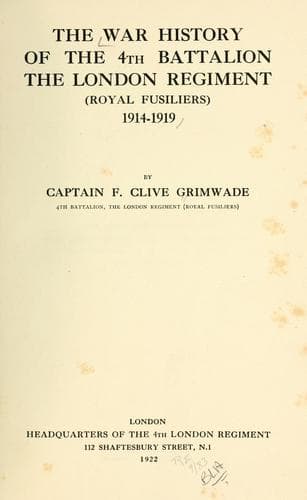
The War History of the 4th Battalion, the London Regiment (Royal Fusiliers), 1914-1919Grimwade, F. Clive
History
The War History of the 4th Battalion, the London Regiment (Royal Fusiliers), 1914-1919
Grimwade, F. Clive
Great Britain. Army. London Regiment. 4th (City of London) Battalion; World War, 1914-1918 -- Regimental histories -- Great Britain
The 1/4th Londons luckily avoided the slaughter of the battle line this
day, for a few minutes prior to its advance from Angle Wood Valley
an order had been despatched to Brigade Headquarters to the effect
that in consequence of the check of the 6th Division in front of the
Quadrilateral the 168th Brigade would not occupy its battle position.
This order was transmitted by Brigade and reached the Battalion during
its advance. Upon receipt of it the Battalion was at once brought back
to its assembly area at Angle Wood Valley where, in common with the
remainder of the Brigade, it remained in bivouacs till the early hours
of the 18th September. This operation cost the Battalion a large number
of casualties among N.C.O.'s and men from the German shell fire, and
one officer, 2/Lieut. J. W. Chapman, wounded.
During these days Angle Wood Valley was a distinctly unhealthy
locality. The German artillery maintained a searching fire over the
whole area, and exacted a fair toll of casualties. The weather,
which a few days previously had shown signs of mending, had once
more turned wet and the shell holes, which formed the only available
cover, became not the most desirable resting-place for the troops. The
strain was great, but the situation was as usual not only borne by all
in the Battalion with an almost stoical resignation, but enlivened
occasionally with those rare flashes of humour which have made the
London soldiers famous during the War in three continents.
The story of the tanks on the 15th September is too well-known to
need elaboration here, and is, moreover, too much outside the actual
experience of the Battalion to allow of more than a passing reference.
The moral effect on the Germans was immense, and considering that their
employment had scarcely passed the experimental stage, the success
gained by them was conspicuous. As was anticipated, however, the tanks
promptly became a mark for a tremendous concentration of enemy fire
which made their room far more desirable than their company. Of the
three attached to the 56th Division one did useful work in the vicinity
of the Quadrilateral, and after trampling down a good deal of wire and
putting an enemy machine-gun team out of action returned to make a
personal report of its adventures. The careers of the other two were
sadly abbreviated, and the end of the day found them derelict--one
west of Bouleaux Wood, and one south-east of Leuze Wood--though not
before they had dealt out a certain amount of destruction to the German
defences.
Orders were received while the Battalion remained in Angle Wood
Valley for the resumption of the offensive on the 18th September. The
objectives on the XIV Corps front were on this occasion very much more
modest than they had been three days earlier, and so far as the 56th
Division was concerned were as follows:
Public-domain text, read in full here on John Shaqi.
Reviews
Reviews
No reviews yet
Be the first to share your thoughts on this work.
Elsewhere in the archive
Join the Discussion
Join the discussion
Sign in to leave a comment or review.
Sign InorCreate an account