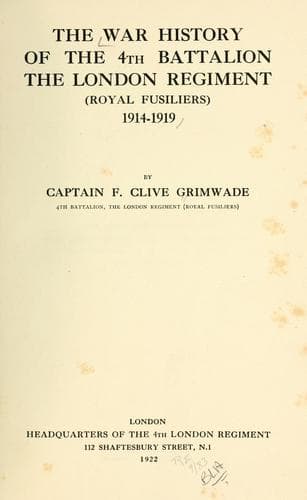
The War History of the 4th Battalion, the London Regiment (Royal Fusiliers), 1914-1919Grimwade, F. Clive
History
The War History of the 4th Battalion, the London Regiment (Royal Fusiliers), 1914-1919
Grimwade, F. Clive
Great Britain. Army. London Regiment. 4th (City of London) Battalion; World War, 1914-1918 -- Regimental histories -- Great Britain
During the night of the 19th a large working party of the 5th Cheshire
Pioneers, under the supervision of the Brigade Major (Capt. R. E.
Neame, V.C., D.S.O., R.E.), and covered by a screen of one and a half
companies of the Scottish, dug a new trench 800 yards long. This new
work, Gropi Trench, ran forward from Beef Trench towards the German
line, parallel to the west edge of Bouleaux Wood, as far as the Morval
tram-line. The task was successfully completed before dawn, but with
the advent of daylight and the consequent exposure of the newly
turned-up earth, the whole brigade area was again subjected to a heavy
bombardment by the enemy's artillery. The German snipers again became
particularly active, and every rash movement was promptly punished.
Under this gruelling there was nothing for the Battalion to do but to
keep quietly in its trenches and make the best of an unpleasant state
of affairs. That night the Kensingtons came forward from Angle Wood
Valley and took over the support line from the Battalion, and also
Bully Trench in front of it. The relief was completed by 9.30 p.m., and
never was relief more welcome. The Rangers at the same time took over
the Beef and Gropi system from the London Scottish. On withdrawal from
the trenches the Battalion moved by companies to bivouacs at Falfemont
Farm, arriving there at 10.45 p.m.
No further movement was made during the 21st and 22nd September, and
these two days were fairly quiet as the principal target for the German
guns was provided by the numerous British batteries in Angle Wood
Valley, which received heavy punishment.
Between the 20th September and the 2nd October the following
reinforcements joined:
Capt. R. N. Keen, Lieuts. W. H. Vernon and A. Bath, 2/Lieuts. C. A.
Speyer, C. Potter, W. R. Gifford, H. W. Spiers, L. C. Haycraft,
L. J. R. Atterbury, C. P. Russell, T. R. Fletcher and S. A. G.
Richardson.
2/Lieut. T. Siddall (25th Londons).
100 N.C.O.'s and men.
A few days after joining Lieut. A. Bath and 2/Lieut. C. P.
Russell were evacuated, the former with a broken ankle, the
latter sick.
The men of this draft represented so far as the 1/4th Battalion was
concerned the firstfruits of the "Derby" scheme, and it must always be
a matter for regret that the dreadful losses already incurred by the
Battalion made it inevitable to pitchfork this fine material straight
into the inferno of the Somme without any opportunity for it to become
previously assimilated into the ranks of the Battalion. The Somme
battles were a severe ordeal even to the most veteran soldiers; and the
bearing of these young and inexperienced troops in the trials of the
latter half of the Battalion's Somme fighting stands to their lasting
credit.
Public-domain text, read in full here on John Shaqi.
Reviews
Reviews
No reviews yet
Be the first to share your thoughts on this work.
Elsewhere in the archive
Join the Discussion
Join the discussion
Sign in to leave a comment or review.
Sign InorCreate an account