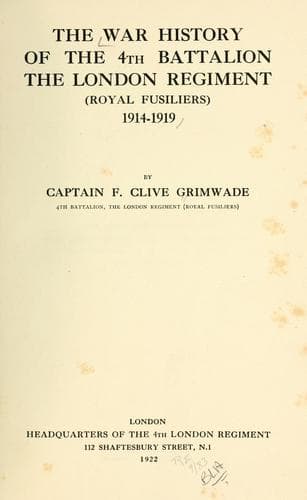
The War History of the 4th Battalion, the London Regiment (Royal Fusiliers), 1914-1919Grimwade, F. Clive
History
The War History of the 4th Battalion, the London Regiment (Royal Fusiliers), 1914-1919
Grimwade, F. Clive
Great Britain. Army. London Regiment. 4th (City of London) Battalion; World War, 1914-1918 -- Regimental histories -- Great Britain
As we have already remarked, the Cockney soldier, however wretched
his conditions, is never so depressed by his surroundings as to be
unable to find humour in the situation of the hour. The Battalion had
now spent seven consecutive days in the desolation of the battle area
practically without shelter from the pitiless torrents of rain which
combined with the German shells to churn the whole surface of the
ground into a disgusting glutinous mass; the troops were soaked to the
skin and plastered with mud from head to foot; but the unconquerable
spirit of cheerfulness held them together, dirty and dishevelled as
they were, a well-knit and disciplined fighting unit. The condition
of the ground, which added so vastly to the labours of the troops, is
illustrated by a story told by an officer who was present:
A man attempted to cross the valley and started to plough his way
through the mud, but rashly omitted to lace up his boots, which he
had previously removed. His negligence was quickly visited upon
him, for scarcely had he begun his journey when the mud claimed one
of his boots, which became stuck fast. His powers of balance were
unequal to the task of putting his foot back in the boot, and he
toppled over, both his hands becoming firmly embedded. His efforts
to regain a standing position were prolonged and violent, but
after a time successful, and finally, boots in hand, he proceeded
on his way amid the cheers of the onlookers, who accepted his
performance as being arranged for their especial amusement, and
were particularly interested in the man's lurid observations on the
subject of boots, mud and war generally.
There were a few occasions, however, when circumstances seemed too
strong even for the 1/4th Londons, and one of them occurred that night
when the rum jars which arrived with the rations were found, alas, to
contain--lime juice!
On the evening of the 22nd September the 168th Brigade was relieved in
the left subsector by the 167th and the Battalion moved back to the
comparative peace of Casement Trench, where it occupied bivouacs until
the afternoon of the 24th, making preparations for the next bout in the
battle line.
_The Battle of Morval, 25th September_
The continuance of the offensive had been arranged for the 21st,
but the weather conditions placed such a handicap on the chances of
success that it was postponed, first until the 23rd and again till
the 25th September, when once more the battle broke out on a front
from the British right at Combles to a point half-way between Flers
and Martinpuich. The French were to co-operate in this attack on the
right of Combles ravine. The objectives of the XIV Corps included the
villages of Lesbœufs and Morval, and, as on the occasion of their
earlier attempt on the 15th, the 56th Division was to form a defensive
flank facing south-east over Combles.
Public-domain text, read in full here on John Shaqi.
Reviews
Reviews
No reviews yet
Be the first to share your thoughts on this work.
Elsewhere in the archive
Join the Discussion
Join the discussion
Sign in to leave a comment or review.
Sign InorCreate an account