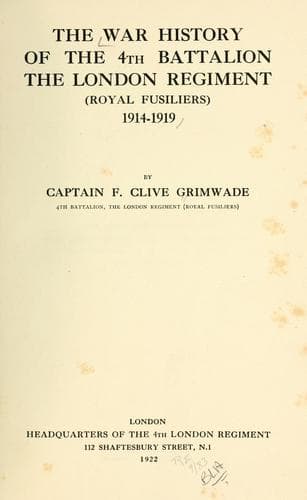
The War History of the 4th Battalion, the London Regiment (Royal Fusiliers), 1914-1919Grimwade, F. Clive
History
The War History of the 4th Battalion, the London Regiment (Royal Fusiliers), 1914-1919
Grimwade, F. Clive
Great Britain. Army. London Regiment. 4th (City of London) Battalion; World War, 1914-1918 -- Regimental histories -- Great Britain
During the evening of relief reports of the full success of the battle
of the 25th September reached the Battalion, including the splendid
news of the fall of the famous series of German redoubts on the
Thiepval Ridge. This welcome intelligence, combined with the knowledge
of the Combles success, put all ranks into the highest spirits, and
created the pardonable expectation that a "break-through" on a large
scale was imminent. How premature these high hopes were the Battalion
was to learn to its cost on the 7th October.
Mention should be made here of the tasks performed by R. S. M. Harris
during the period the Battalion was operating in the Leuze Wood and
Bouleaux Wood area. He was responsible for organising all carrying
parties up to advanced Battalion Headquarters with water, rations and
munitions. These duties he carried out in a highly praiseworthy manner,
both he and his small band of carriers being continually called upon
day and night to tramp up the long Angle Wood Valley, often in the
rain, on practically impassable tracks and more often than not under
shell fire. "As Adjutant," writes Boutall, "I highly appreciated the
assistance he gave me in thus relieving me of a considerable amount of
additional work and anxiety. I do not remember a single instance during
this whole period when he failed us, in spite of the difficult and
heavy tasks we were obliged to impose on him."
_The Battle of the Le Transloy Ridges 1st-18th October_
Owing to the shortening of the line consequent upon the fall of
Combles, and the extension to their left of the French, the 56th
Division was now withdrawn and moved out of the battle area, the
Battalion marching at 2 p.m. on the 28th Sept. from Casement to
Ville-sur-Ancre, where rough but welcome billets were occupied. The
Division's rest was destined to be short-lived, for the following day a
warning order was received that it would take the place in the line of
the 6th and Guards Divisions, which had suffered considerably during a
prolonged period in action.
The Battalion at this stage was unfortunate in losing Lieut.-Col.
Wheatley. The prolonged exposure had already undermined his health, and
at this period he was recommended a rest by the Medical Authorities. He
refused to go to hospital, and compromised by going to the Divisional
Rest Station, Major H. J. Duncan-Teape taking command, but so keen
was the Colonel to be with his unit, that without having sufficiently
recovered he returned on October 2nd.
Public-domain text, read in full here on John Shaqi.
Reviews
Reviews
No reviews yet
Be the first to share your thoughts on this work.
Elsewhere in the archive
Join the Discussion
Join the discussion
Sign in to leave a comment or review.
Sign InorCreate an account