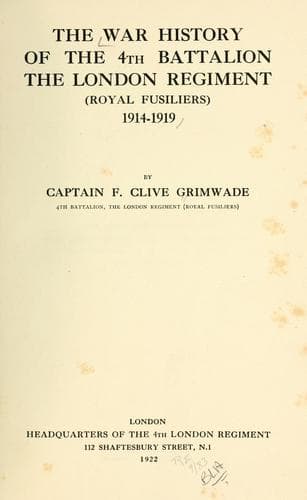
The War History of the 4th Battalion, the London Regiment (Royal Fusiliers), 1914-1919Grimwade, F. Clive
History
The War History of the 4th Battalion, the London Regiment (Royal Fusiliers), 1914-1919
Grimwade, F. Clive
Great Britain. Army. London Regiment. 4th (City of London) Battalion; World War, 1914-1918 -- Regimental histories -- Great Britain
The sector to be occupied was about 2000 yards in frontage, running in
a north-west to south-east direction through the eastern outskirts of
Lesbœufs, and was taken over on the evening of the 30th September with
the 169th Brigade on the right, and the 167th on the left, the dividing
line being the Lesbœufs-Le Transloy Road. The left subsector (or
northern half of the line) lay just below the crest of the ridge above
Lesbœufs, and orders were issued for the advancement of this part of
the line to positions from which direct observation could be obtained
over the German positions in front of Le Transloy, in preparation for
an early renewal of the offensive.
[Illustration: THE BATTLE OF THE LE TRANSLOY RIDGE, OCTOBER 1916]
The 168th Brigade remained in Divisional reserve, and on the morning
of the 30th the Battalion, together with the London Scottish, moved
forward to their former bivouac area between Trones and Bernafay Woods,
the Kensingtons and Rangers remaining at the Citadel.
The Battalion remained in the Trones Wood area during the 1st and 2nd
October, and a Brigade relief having been ordered for the following
day, moved forward at 4.30 p.m. to Lesbœufs, relieving the 2nd Londons.
The positions taken over by the Battalion formed the left subsector
of the Brigade front and extended from the Lesbœufs-Le Transloy Road,
which formed the left boundary, for some 800 yards southwards to the
junction with the London Scottish, who were in line on the right,
the latter battalion being the right flank of the British Army. The
Kensingtons moved into Brigade support in the old Morval-Flers line,
and the Rangers occupied bivouacs at Ginchy.
The main position taken over by the Battalion was a roughly constructed
trench known as Shamrock, about 50 yards east of the sunken road
leading from Lesbœufs to Morval. In advance of this main position,
which was allotted to A and B Companies, were a number of embryo
trenches in varying stages of construction and quite isolated from
the main line. Of these isolated trenches the chief was Rainy, which
adjoined the Lesbœufs-Le Transloy Road, about 300 yards ahead of
Shamrock, and Foggy, some distance farther south and separated from
Rainy by a gap of probably 300 yards. C and D Companies and Battalion
Headquarters took up positions in the old Lesbœufs-Gueudecourt line
west of the village.
The resumption of the offensive was imminent; and it was indeed first
fixed for the 5th October, though subsequently postponed till the 7th
owing to the continuance of adverse weather conditions.
Public-domain text, read in full here on John Shaqi.
Reviews
Reviews
No reviews yet
Be the first to share your thoughts on this work.
Elsewhere in the archive
Join the Discussion
Join the discussion
Sign in to leave a comment or review.
Sign InorCreate an account