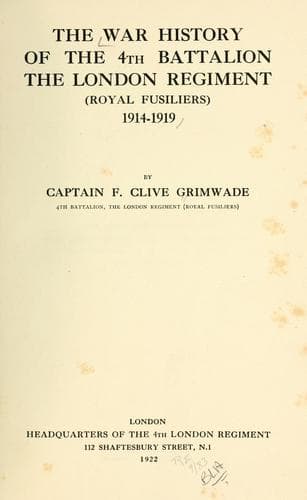
The War History of the 4th Battalion, the London Regiment (Royal Fusiliers), 1914-1919Grimwade, F. Clive
History
The War History of the 4th Battalion, the London Regiment (Royal Fusiliers), 1914-1919
Grimwade, F. Clive
Great Britain. Army. London Regiment. 4th (City of London) Battalion; World War, 1914-1918 -- Regimental histories -- Great Britain
A great deal of constructional work was immediately necessary in
assembly and communication trenches, as well as in the completion
of the necessary advanced dumps of munitions and stores of all
kinds. Working parties from the Battalion, of the greatest available
strength, began work on part of these tasks on the night of the 4th,
the new trenches to be dug comprising communications to join Rainy
with Shamrock and with a small advanced position on the crest of the
ridge overlooking Le Transloy. In addition the road at Rainy was
barricaded. Large working parties were also provided by the Kensingtons
to provide an advanced assembly position for the attack by connecting
Rainy and Foggy, and by the Cheshire Pioneers and the R.E.'s on other
tasks. This latter task, however, could not be completed in one night
and was continued the following evening. The shocking state of the
ground prevented it from ever being finished, and on the day of the
attack only about 150 yards of trench had been added to Foggy. On the
night of the 6/7th also a fresh assembly trench for the use of the
centre battalion was taped out by the Brigade Major, and dug by the
Kensingtons. This work was called New Trench.
Although the weather once again had embarked on a dry spell the
long continued rains had rendered working tasks immensely difficult
of accomplishment, and the tenacious character of the mud added
incalculably to the labour of digging and of reaching the site of the
work. The isolation of the various tasks in this appalling swamp, from
which every landmark had been swept out of existence, and the constant
harassing fire of the enemy's machine-gunners, caused great delays to
working parties in even locating their work, and all these factors
together tended to reduce the work actually carried out far below
expectations.
The Battalion, not being originally detailed for the assault, was
relieved in the trenches on the evening of the 5th by the Rangers and
moved by companies on relief to bivouacs between Ginchy and Guillemont,
leaving A and C Companies in line for the completion of their tasks
begun the previous night. The following day, however, intimation was
received of a change of orders, and the Battalion returned to the
trenches that night as the centre assaulting battalion of the Brigade,
its place in brigade support being taken by the Kensingtons.
Public-domain text, read in full here on John Shaqi.
Reviews
Reviews
No reviews yet
Be the first to share your thoughts on this work.
Elsewhere in the archive
Join the Discussion
Join the discussion
Sign in to leave a comment or review.
Sign InorCreate an account