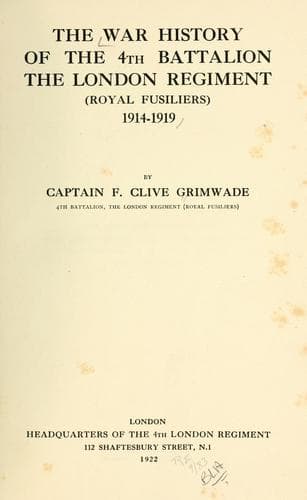
The War History of the 4th Battalion, the London Regiment (Royal Fusiliers), 1914-1919Grimwade, F. Clive
History
The War History of the 4th Battalion, the London Regiment (Royal Fusiliers), 1914-1919
Grimwade, F. Clive
Great Britain. Army. London Regiment. 4th (City of London) Battalion; World War, 1914-1918 -- Regimental histories -- Great Britain
The gun pits which had been allotted to the two platoons of D Company
in New Trench were found to be alive with bravely-manned machine-guns,
and under their withering fire D Company simply melted out of
existence. C Company, following slightly to its right, was able to
avoid total extinction by taking cover in shell holes in dead ground
close by, but 2/Lieut. C. M. Taylor fell under this fire at the head
of the leading wave of the Company. B Company, following on from
Shamrock, met the full blast of the enemy counter-barrage, and suffered
heavy losses, but pushed bravely on and eventually filtered into the
same general line as was already held by C Company and the remains of
D. Under the devastating fire from the gun pits further advance was
impossible, and the troops continued to suffer loss where they lay. The
afternoon wore on and the Battalion remained clinging to its position,
about 50 yards from its starting-point, until after dark. Sergt. H. F.
Page of D Company displayed magnificent coolness, and from his shell
hole passed a busy afternoon picking off the German gunners in the
pits with great deliberation. He was subsequently commissioned to the
King's Own Regiment (Royal Lancaster). All ranks alike were exposed to
the fire and all suffered proportionately. L. C. Haycraft, a promising
young subaltern of D Company who had already proved his worth with the
bombers of the Civil Service Rifles in the Hairpin at Hulluch, made
an attempt after dark to ascertain the enemy's position, but he never
returned from his reconnaissance.
Gifford, in charge of B Company, also fell, as did his platoon
commanders, Fletcher and Richardson, the two last wounded; and C.S.M.
James, who received the Military Medal for his good work, took charge
of the Company and brought it out of action at the end of the day.
On the left the Rangers had met with a similar fate at the hands of
the machine-gunners in Dewdrop Trench, before whose fire they had been
stopped dead with ghastly loss immediately they rose from the assembly
trench.
The London Scottish, on the right, gained a little success, their right
flank achieving a maximum advance of about 400 yards, but their left
felt the blast of the deadly guns in the pits, and they were kept out
of all except the southern extremity of Hazy.
At about 8.30 p.m. the enemy delivered a counter-attack from Hazy and
Dewdrop under heavy artillery support, which had the effect of forcing
the Brigade definitely back to its starting trenches.
In the meantime a company of the Kensingtons had been brought up to
Burnaby with the idea of forcing the Dewdrop position by outflanking
it from the north, but the Germans being found still strongly in
possession of Spectrum, north of the road, the attack was cancelled.
Public-domain text, read in full here on John Shaqi.
Reviews
Reviews
No reviews yet
Be the first to share your thoughts on this work.
Elsewhere in the archive
Join the Discussion
Join the discussion
Sign in to leave a comment or review.
Sign InorCreate an account