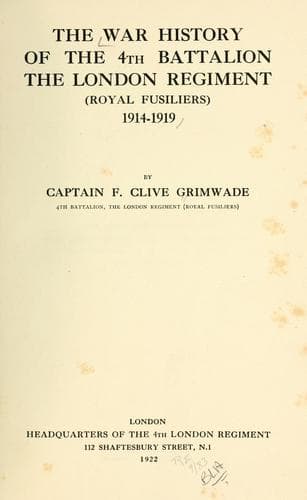
The War History of the 4th Battalion, the London Regiment (Royal Fusiliers), 1914-1919Grimwade, F. Clive
History
The War History of the 4th Battalion, the London Regiment (Royal Fusiliers), 1914-1919
Grimwade, F. Clive
Great Britain. Army. London Regiment. 4th (City of London) Battalion; World War, 1914-1918 -- Regimental histories -- Great Britain
It having become obvious that the assaulting battalions were
dangerously weakened, immediate reliefs were arranged, and the
Battalion that night handed over its position to the Queen Victorias,
who were attached to the Brigade, and withdrew to the bivouacs at
Trones Wood. Here it was joined by the London Rifle Brigade. The
withdrawal of the Battalion was supervised by Major Duncan-Teape,
who managed by great efforts to get the whole of the remnants of the
companies back over the Ridge just before daylight broke. The roll call
at Trones Wood was a gloomy spectacle, for neither the 1/4th Londons
nor the London Scottish could muster more than the strength of about
one company.
The total losses in all ranks sustained by the Battalion on this
unfortunate day amounted to about 300 all ranks, the casualties among
officers being:
Killed--Lieut. W. H. Vernon, 2/Lieuts. C. M. Taylor, W. H. Gilford,
L. J. R. Atterbury and L. C. Haycraft.
Wounded--Capt. R. N. Keen and 2/Lieuts. T. R. Fletcher, H. W.
Spiers and S. A. G. Richardson.
Of this, the last of the Battalion's actions in the great Somme
battles, but little more need be said. The position which it had been
proposed to carry with three weak battalions was attempted again the
following day with equal lack of success; and subsequently other
Divisions suffered heavy casualties in the unsuccessful endeavour.
Indeed the position never did fall into our possession until the enemy
deliberately gave it up in his retirement of the succeeding February on
to the Hindenburg line.
Lieut.-Col. L. L. Wheatley, D.S.O., had led the Battalion through many
trying ordeals with the unfailing confidence of all ranks who had the
honour to be under his command; but as already indicated, the strain of
the long-protracted struggle, especially of the last few days, combined
with continually wet clothes, had proved too much for him, and he now
contracted an acute attack of dysentery and was evacuated to hospital
on the 10th. He never returned to the Battalion which his compelling
personality had made essentially his own.
On the 11th October the Battalion moved to the Citadel Camp, the
gateway through which thirty-five days earlier it had entered
the inferno of the battle; and the Division being concentrated
here after relief by the 4th Division, it marched the following
morning to Ville-sur-Ancre, moving thence by motor-buses to a rest
area north-west of Amiens, billets being provided for it at St
Vaast-en-Chaussée.
Public-domain text, read in full here on John Shaqi.
Reviews
Reviews
No reviews yet
Be the first to share your thoughts on this work.
Elsewhere in the archive
Join the Discussion
Join the discussion
Sign in to leave a comment or review.
Sign InorCreate an account