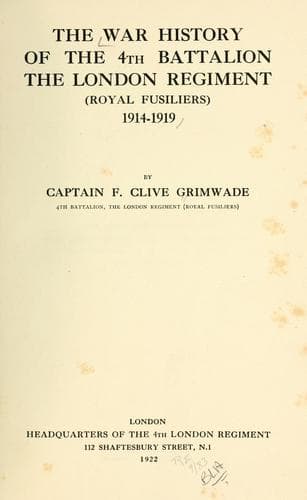
The War History of the 4th Battalion, the London Regiment (Royal Fusiliers), 1914-1919Grimwade, F. Clive
History
The War History of the 4th Battalion, the London Regiment (Royal Fusiliers), 1914-1919
Grimwade, F. Clive
Great Britain. Army. London Regiment. 4th (City of London) Battalion; World War, 1914-1918 -- Regimental histories -- Great Britain
Of all the great series of actions of the War the battles of the Somme
in 1916 stand out perhaps in the public memory as the most heroic, and
at the same time the most appalling, and we cannot leave the subject
finally without a few remarks generally reviewing the Battalion's
experiences. Of the thirty-five days spent in XIV Corps area only four
had been spent in rest bivouacs, and during the remaining thirty-one
the Battalion had taken part in active operations five times. The
losses incurred amounted to the enormous total of nearly 700 in all
ranks, of whom 40 were officers.
It would be unfitting to close our account of the Somme battles without
paying some tribute to the magnificent work performed throughout by
Rear Headquarters under Major H. J. Duncan-Teape. The administrative
ranks of a battalion in action are invariably worked to the limits
of human endurance, but usually with inadequate recognition of their
importance; for it is no exaggeration to say that on the efficiency
with which they maintain the stream of supplies, whether of rations or
munitions, to the fighting ranks, depends not merely the success, but
the very existence of the troops in advanced positions. On the Somme
the consistently atrocious weather increased tenfold the fatigue and
strain of the administrative portion of the Battalion: the mud swamps
which had to be traversed, the severe shell fire which plastered all
back areas, the wretched misery of the whole struggle, and above all
the vast responsibility which rested on them, all combined to make
the work of Rear Headquarters an enormous strain both mental and
physical. But throughout the battles Major Duncan-Teape was constantly
alert and constantly at advanced Headquarters, ascertaining exactly
what was wanted, and getting it done. In Lieut. H. B. A. Balls, the
Acting Quartermaster, and in R.S.M. Harris he found able and devoted
lieutenants whose cool handling of all difficulties was invaluable.
The transport sections of all battalions were brigaded under Capt. L.
G. Rix at the Citadel, and the 1/4th Londons' transport section under
Lieut. G. V. Lawrie worked throughout magnificently and never once
failed to deliver the day's supplies. Those who were present will fully
appreciate what this means. The work for horses and men was exhausting
and incessant; and oftentimes the limbers returned from the forward
area to the transport lines only just in time to load up once more for
the upward journey. The results that were obtained could only have been
achieved by the whole-hearted devotion of all ranks.
Of the men in the companies on whom day after day fell the burden
of physical discomfort and mental strain it is impossible to speak
adequately. The record of their achievements speaks, and can be left to
speak, for itself.
The decorations awarded for services rendered between the 1st July and
the 7th October were:
Public-domain text, read in full here on John Shaqi.
Reviews
Reviews
No reviews yet
Be the first to share your thoughts on this work.
Elsewhere in the archive
Join the Discussion
Join the discussion
Sign in to leave a comment or review.
Sign InorCreate an account