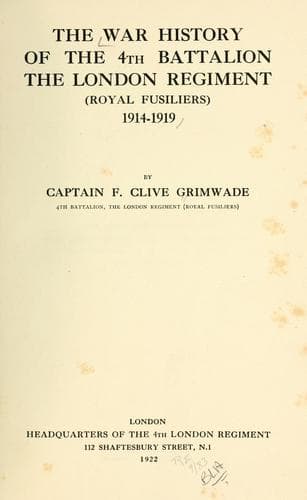
The War History of the 4th Battalion, the London Regiment (Royal Fusiliers), 1914-1919Grimwade, F. Clive
History
The War History of the 4th Battalion, the London Regiment (Royal Fusiliers), 1914-1919
Grimwade, F. Clive
Great Britain. Army. London Regiment. 4th (City of London) Battalion; World War, 1914-1918 -- Regimental histories -- Great Britain
A course of light training was continued for a few days at Citerne
under weather conditions which continued bright and frosty until the
evening of the 24th October, when the Battalion marched at 8 p.m. in a
veritable deluge to Longpré Station to entrain for a fresh area. The
pitiless rain drenched all to the skin, but the men's spirits remained
completely undamped, for the rumour had gone forth that the new area
was far from the Somme, among the marshes of Flanders. The move from
Longpré was made by tactical train shortly after midnight, and about
midday on the 25th the Battalion detrained at Merville, whence it
marched straight to billets between Neuf Berquin and Estaires, being
now attached to the XI Corps (Haking) of the First Army (Horne).
No prolonged rest was, however, in store, for although the Battalions
of the 56th Division were momentarily not prepared for active
operations, they were perfectly capable of holding trenches. No
surprise, therefore, was caused by the receipt the day following
arrival at Neuf Berquin of orders to relieve the 61st Division in the
Neuve Chapelle-Fauquissart area.
A preliminary reconnaissance of the trenches by officers of Battalion
Headquarters and company commanders took place on the 26th, and on
the 27th the 1/4th Londons and London Scottish moved forward and
took over reserve billets in Laventie from the 2/7th and 2/8th Royal
Warwickshires.
On the 28th October the 168th Brigade completed the relief of the 182nd
Brigade, the 1/4th Londons and Scottish moving into the right and left
subsections respectively of the Fauquissart sector, there relieving
the 2/6th and 2/5th Royal Warwickshires, while the reserve billets in
Laventie were taken over by the Kensingtons and Rangers.
The new Divisional frontage covered some 7000 yards from the
neighbourhood of Richebourg l'Avoué on the right to a point opposite
Rouges Bancs on the left, all the Brigades being in line and each
finding its own supports and local reserves. The 168th Brigade held the
extreme left of the Divisional front, the 169th being on its right,
while the New Zealand Division was on its left. This extreme deployment
of a numerically weak Division was justified by the quiet character
of this area, and the fact that the German divisions opposed to it
were equally with ourselves somewhat exhausted by recent efforts in
the Somme battles and not anxious to venture on active operations. To
such an extent indeed had our continued pressure in the south drained
the enemy's resources that his lines opposite the 56th Division were
but feebly held, and at the moment not capable of being strongly
reinforced; and this area was therefore eminently suited to the
recuperation of a battle-worn Division and to the training in active
service conditions of the young troops from home who were shortly to
join it.
Public-domain text, read in full here on John Shaqi.
Reviews
Reviews
No reviews yet
Be the first to share your thoughts on this work.
Elsewhere in the archive
Join the Discussion
Join the discussion
Sign in to leave a comment or review.
Sign InorCreate an account