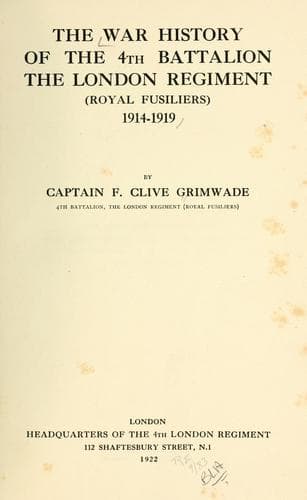
The War History of the 4th Battalion, the London Regiment (Royal Fusiliers), 1914-1919Grimwade, F. Clive
History
The War History of the 4th Battalion, the London Regiment (Royal Fusiliers), 1914-1919
Grimwade, F. Clive
Great Britain. Army. London Regiment. 4th (City of London) Battalion; World War, 1914-1918 -- Regimental histories -- Great Britain
The Fauquissart breastworks were in every way similar to those in
the Neuve Chapelle area already described in connection with the
Battalion's service in the Indian Corps, though being opposite the
village of Aubers, which is on the highest part of the Ridge, were even
more seriously subject to observation from the enemy lines than the
Richebourg breastworks.
The village of Fauquissart, at this period in a condition of total
ruin, consisted of a scattered collection of houses extending for about
half a mile along each side of the Rue Tilleloy, which ran parallel
with the British front breastworks and about 200 yards in rear of them.
A thousand yards in rear of the Rue Tilleloy, and parallel to it, was
the Rue Bacquerot, these two roads forming good lateral communication
within the sector, though the former could only be used under cover of
darkness. The sector was also served by three communication trenches
starting from the Bacquerot, Elgin Street, Masselot Street and the
Strand, the last named during the winter months usually consisting of a
chain of unfordable lakes.
This sector was held by the Battalion with three companies in line and
one in reserve, the reserve company holding three keeps on the line
of the Rue Bacquerot, called Road Bend, Wangerie and Masselot Posts.
Battalion Headquarters was accommodated in shelters near Temple Bar on
the Rue Bacquerot.
The German lines opposite were heavily wired, and included two strongly
marked salients, the Devil's Jump and the Wick. But although the enemy
had the advantage in observation owing to his possession of the Ridge,
his front trenches were far from comfortable owing to the presence
behind his lines of the Rivière des Laies which, as the winter wore on,
became more and more swollen, finally bursting its banks and rendering
his forward defences completely untenable.
Our wire entanglements were exceedingly poor, and immediate attention
was directed to the improvement of this important part of our defences;
the parapets also were thin, firebays sadly in need of revetment, and
the whole sector seriously lacking in shelter for the men. No time
was lost in evolving an extensive works programme, which was promptly
put into execution, the more important work being carried out under
Royal Engineer supervision. The urgency of the Brigade works programme
rendered the supply of large working parties necessary, and it was
therefore arranged that of the two battalions for the time being
in Laventie one would act as "Works Battalion" finding all working
parties, while the other would devote itself to training.
Public-domain text, read in full here on John Shaqi.
Reviews
Reviews
No reviews yet
Be the first to share your thoughts on this work.
Elsewhere in the archive
Join the Discussion
Join the discussion
Sign in to leave a comment or review.
Sign InorCreate an account