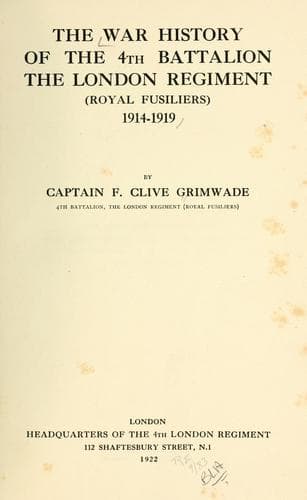
The War History of the 4th Battalion, the London Regiment (Royal Fusiliers), 1914-1919Grimwade, F. Clive
History
The War History of the 4th Battalion, the London Regiment (Royal Fusiliers), 1914-1919
Grimwade, F. Clive
Great Britain. Army. London Regiment. 4th (City of London) Battalion; World War, 1914-1918 -- Regimental histories -- Great Britain
During the third week in November the Battalion's frontage was extended
to the right, involving the occupation by the right company of an extra
400 yards of breastwork and an additional supporting post, Erith, and
by the reserve company of a fourth keep on the Bacquerot line called
Lonely Post. This new piece of breastwork was usually subjected to a
good deal of enemy trench mortar fire, especially about the point at
which Erith Street communication trench joined the front line. This
was an unpleasant spot. Erith Street sunk into a slight depression so
that all traffic using it was plainly visible to the Germans; and as
it came to an abrupt end some fifteen yards short of the front line
an undesirable gap occurred which had to be traversed with more than
ordinary agility by those whose duty took them that way. A good deal
of extra trench repairing work was imposed on us in consequence of the
enemy's attentions at this point, and unfortunately some casualties
occurred.
The enemy's activity was rather marked on the 26th November, during the
morning of which day over seventy 5·9-inch shells fell near the Convent
observation post but without a direct hit being obtained. The Convent,
together with two or three other posts along the line of the Rue
Tilleloy, used by the forward observation officers of our supporting
artillery, consisted of a substantial brick tower some 25 feet in
height, like an attenuated Martello Tower. These had been erected
behind the cover of the houses of Fauquissart before the village had
been destroyed. But the subsequent demolition of the houses had exposed
the towers, which consequently stood up naked and unashamed within 200
yards of our front line, and their presence, possibly combined with
his evident inability to hit them, seemed to be a constant source of
annoyance to the enemy.
All this time the Battalion strength was steadily increasing with
reinforcements from home and with the return of many who had been
wounded on the Somme, till by Christmas it mustered some 700 all ranks.
Officer reinforcements followed on each other's heels with surprising
rapidity, and the following joined during November:
Captains V. S. Bowater and H. M. Lorden, Lieuts. H. Jones
(appointed Brigade Bombing Officer) and H. J. M. Williams,
2/Lieuts. E. G. Dew, L. W. Wreford, S. P. Stotter, H. W.
Spiers, R. W. Chamberlain and W. A. Froy; 2/Lieuts. H. N.
Williams, L. W. N. Jones, H. D. Rees, Bradley (to 168th L.T.M.
Battery) and A. L. Harper (attached from 4th Royal Welsh
Fusiliers); 2/Lieuts. F. H. Hutchins, A. G. Davis and L. E.
Ballance (attached from 11th Londons); Captain H. Pentelow and
Lieuts. T. Coleman (Works Officer) and H. D. Beeby (attached
from Hunts Cyclist Battalion).
Captain Pentelow was unluckily hit and sent to hospital two days after
his arrival.
Public-domain text, read in full here on John Shaqi.
Reviews
Reviews
No reviews yet
Be the first to share your thoughts on this work.
Elsewhere in the archive
Join the Discussion
Join the discussion
Sign in to leave a comment or review.
Sign InorCreate an account