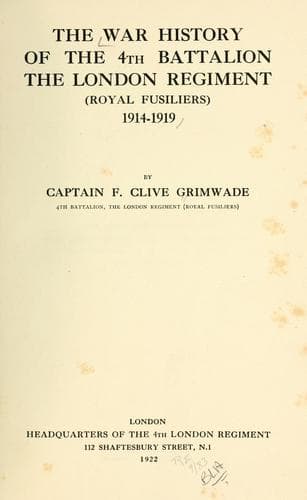
The War History of the 4th Battalion, the London Regiment (Royal Fusiliers), 1914-1919Grimwade, F. Clive
History
The War History of the 4th Battalion, the London Regiment (Royal Fusiliers), 1914-1919
Grimwade, F. Clive
Great Britain. Army. London Regiment. 4th (City of London) Battalion; World War, 1914-1918 -- Regimental histories -- Great Britain
The most peculiar feature of this sector lay in the immunity from shell
fire of Laventie behind the British lines and of Aubers in the German
territory. Each village layabout 2000 yards in rear of the respective
front trenches, and both were used as reserve billets for the troops
holding the line. By mutual and tacit consent the artillery on each
side refrained from bombarding the other's billets; any infringement
of this unwritten law on one side being met with immediate and severe
retaliation by the other. During the period therefore spent in
the Laventie area, the Battalion on coming out of the line had the
enjoyment of occupying tolerably wind-and water-tight billets without
molestation, although they were distant little more than a mile from
the enemy lines. A considerable number of civilians still clung to
their battered homes in Laventie, and it was strange to see French
soldiers, whose divisions were serving in Alsace or the Argonne, come
to Laventie "on leave from the front"!
The 1/4th Londons now settled down to a regular routine of four days in
the right subsection breastworks followed by four days in billets in
Laventie, tours being later extended to six days, and as this routine
continued until the middle of December we need not follow it in detail.
The sector had been particularly quiet prior to the 56th Division's
arrival, but almost from the day of its taking over the line conditions
began to change. Possibly a certain undesirable aggressiveness on
the part of the Londoners began to annoy an enemy who, but for
interference, was content to conduct a perfectly peaceful war; possibly
the change was due to the recovery of both sides from the fatigue and
over-strain of the Somme. Whatever the reason, certain it is that as
the winter wore on the whole Neuve Chapelle-Fauquissart area began
to become much more lively than it had been. On our side the most
vigorous system of patrolling, of daily organised shoots by guns of all
calibres, trench mortars and machine-guns, and of an intensive course
of sniping, quickly gave us the ascendancy and caused the Germans a
pardonable irritation under which they showed themselves less and less
disposed to take their punishment quietly.
In the line the Battalion was busily occupied with its share of
the works programme and in patrolling in which the infrequency of
encounters with the enemy in No Man's Land gradually led to the belief
that his front breastwork was not occupied. This was probed further on
the last evening of November when a fighting patrol of twenty men under
2/Lieut. W. H. Webster (Intelligence Officer) entered the enemy lines
at the Wick Salient and found it untenanted, in a shocking condition of
flood and affording ample evidence that no attempt was being made to
repair the serious damage caused by our artillery fire.
Public-domain text, read in full here on John Shaqi.
Reviews
Reviews
No reviews yet
Be the first to share your thoughts on this work.
Elsewhere in the archive
Join the Discussion
Join the discussion
Sign in to leave a comment or review.
Sign InorCreate an account