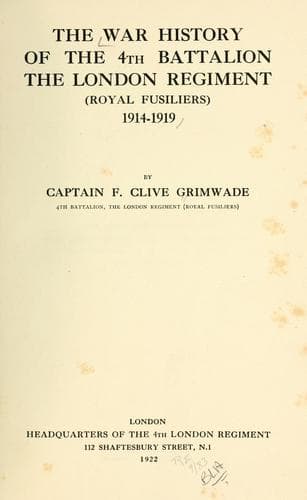
The War History of the 4th Battalion, the London Regiment (Royal Fusiliers), 1914-1919Grimwade, F. Clive
History
The War History of the 4th Battalion, the London Regiment (Royal Fusiliers), 1914-1919
Grimwade, F. Clive
Great Britain. Army. London Regiment. 4th (City of London) Battalion; World War, 1914-1918 -- Regimental histories -- Great Britain
On the evening of the 9th January 1917 the Battalion took over from
the Kensingtons the right subsection of the Moated Grange sector.
This sector had seen a good many changes both as regards defences and
boundaries since the Battalion's previous occupation of it in the
summer of 1915, and the lines now taken over extended from Sign Post
Lane on the right for a frontage of some 1400 yards to a point opposite
the village of Mauquissart which lay just within the German lines.
[Illustration: LAVENTIE, WINTER 1916-1917]
The sector was held with three companies in the front breastworks
and supporting posts and one in reserve on Cardiff Road. Battalion
Headquarters occupied shelters at Ebenezer Farm. These positions were
far from ideal. The strength of the Battalion was much scattered
and difficult of control in emergency, owing to the exceedingly bad
communications within the area. The supporting platoons of the front
line companies, at Bristol House, Cornwall Siding and Pump House,
occupied the only remaining tenable portions of what had originally
been the German second line prior to the Battle of Neuve Chapelle, and
were separated from each other by about 100 yards of broken down and
almost impassably wet breastworks. For communication from front to rear
only one trench, Tilleloy South, was passable with any degree of safety
in daylight. Between Pump House and the front line, a distance of
about 250 yards, it was seriously overlooked from the German positions
in the Bois du Biez, with the result that traffic up and down it was
frequently sniped with trench mortar and 5·9 shells.
Always an area of considerable activity, the Moated Grange possessed
several unpleasant features as a result of the active mining operations
which had begun in 1915, and were still proceeding with unabated
energy. The Duck's Bill Farm had given place to an enormous crater
of the same name, linked with the British lines by a defended sap
which left the front line at Sunken Road. The defence of this crater
and sap took a platoon, whose arduous duties of continual listening
and constant preparedness for an enemy raid were carried out under
exceedingly rough conditions, as both the crater and the sap were full
of water and shelters were conspicuous by their absence.
Public-domain text, read in full here on John Shaqi.
Reviews
Reviews
No reviews yet
Be the first to share your thoughts on this work.
Elsewhere in the archive
Join the Discussion
Join the discussion
Sign in to leave a comment or review.
Sign InorCreate an account