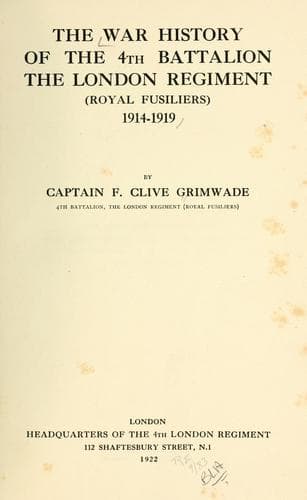
The War History of the 4th Battalion, the London Regiment (Royal Fusiliers), 1914-1919Grimwade, F. Clive
History
The War History of the 4th Battalion, the London Regiment (Royal Fusiliers), 1914-1919
Grimwade, F. Clive
Great Britain. Army. London Regiment. 4th (City of London) Battalion; World War, 1914-1918 -- Regimental histories -- Great Britain
On the front occupied by the left company the German lines were
invisible from the British breastworks owing to the lips thrown up
round the Colvin craters, a series of some thirty or more of immense
size which covered half the area of No Man's Land at this point. The
largest of this series, the Mauquissart crater, occupied the site of
what had once been our front line, and the breastwork now ran round
its nearer lip. This mined area was the most uncomfortable part of
the line, since the Germans were continually searching with trench
mortar fire for the heads of our mine shafts while the cover afforded
to enemy patrols by the crater lips themselves necessitated constant
vigilance and counter-patrolling activity on the part of our trench
garrison. Add to this the extreme hardship which the troops in this
part of the line inevitably had to undergo owing to the total lack of
dugouts and the perishing cold. The blowing of so many craters had,
moreover, cut off the ditches between fields which had formerly been
used for draining the trenches, with the result that there was no
means of getting rid of the water which in a large number of firebays
rose higher than the firestep. Under these conditions cooking in the
neighbourhood of the front line was out of the question, and all cooked
food had to be carried by permanent headquarter carrying parties from
the Battalion cook-house near Ebenezer Farm; in the case of rations
destined for the flank platoons this meant a trudge for the food
carriers of over a mile in each direction at each meal.
The defences generally had suffered severely both from the enemy's
shell fire and the effects of the alternation of sharp frost and
heavy rain, and an immense amount of labour was called for in
working and carrying parties for the breastworks as well as for the
wire entanglements, which were in a very weak condition. The single
communication trench, therefore, became frequently congested with long
lines of troops "humping" material and food to the front line, and
altogether the Moated Grange was a hard sector to run efficiently and a
remarkably unpleasant one to live in.
Public-domain text, read in full here on John Shaqi.
Reviews
Reviews
No reviews yet
Be the first to share your thoughts on this work.
Elsewhere in the archive
Join the Discussion
Join the discussion
Sign in to leave a comment or review.
Sign InorCreate an account