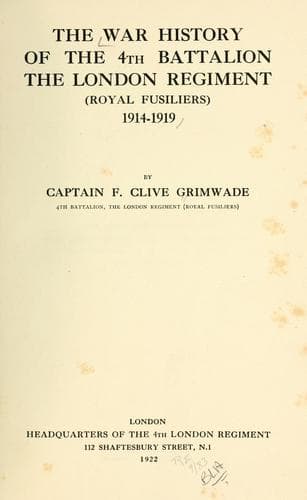
The War History of the 4th Battalion, the London Regiment (Royal Fusiliers), 1914-1919Grimwade, F. Clive
History
The War History of the 4th Battalion, the London Regiment (Royal Fusiliers), 1914-1919
Grimwade, F. Clive
Great Britain. Army. London Regiment. 4th (City of London) Battalion; World War, 1914-1918 -- Regimental histories -- Great Britain
It had been the intention that the 168th Brigade should pass fourteen
days in rest, but this idea had to be unexpectedly abandoned owing to a
concentration of troops near the frozen inundations of the Yser, where
it was feared that a sudden German advance over the ice might have
somewhat disturbing effects on the Allies' positions. This caused the
services of the 168th Brigade to be requisitioned once more, and on the
1st and 2nd February it relieved the 111th Brigade of the 37th Division
in the Neuve Chapelle sector, the Rangers and Kensingtons occupying the
line, while the Scottish moved as Works Battalion to billets at Croix
Barbée and the 1/4th Londons as Training Battalion to Fosse.
On the 1st February 2/Lieut. C. E. V. Richardson was admitted to
hospital.
After training at Fosse for six days the 1/4th Londons took over from
the Kensingtons the right subsector of Neuve Chapelle sector on the 8th
February.
The Battalion now found itself after a lapse of over a year once more
in the area in which it had passed so many months with the Ferozepore
Brigade. The sector taken over comprised the old Rue du Bois (right,
centre and left) sections, and extended from a point opposite the
German Boar's Head Salient on the right to some 250 yards north of the
La Bassée Road on the left. Considerable changes had now taken place
in the method of holding the line; old well-known trenches had fallen
into disuse and fresh ones had taken their places. Those who looked for
the Crescent, Orchard Redoubt, and other well-remembered spots found
them broken down and no longer occupied. The front line breastwork was
now occupied in isolated posts at intervals of about 150 yards, each
garrisoned by a platoon. Each post was protected on its flanks as well
as in front by wire entanglements, while the intervening firebays had
been either filled in or choked with barbed wire.
The communications within the sector were tolerably good, but the
breastwork was thin and in many places low, a natural result of leaving
long portions of it unoccupied for several months.
The main line of resistance was now in the reserve or "B" line which,
on the right of the sector, was represented by Guards Trench in front
of the Rue du Bois, and on the left by the old British front line (as
it had been before the Battle of March 1915) in Edgware Road. Battalion
Headquarters in 1915 had occupied dugouts on the Rue du Bois, but were
now at Lansdowne Post, which formerly had housed a whole battalion. The
defence scheme provided for holding the "B" line at all costs in the
event of serious attack, so that the front line became virtually a line
of outposts. This method of holding the line in great depth was not
only far sounder than the former method of crowding the whole strength
into the front trench, but was also more economical, as the sector
which formerly had demanded a garrison of a whole brigade was held by
one battalion.
Public-domain text, read in full here on John Shaqi.
Reviews
Reviews
No reviews yet
Be the first to share your thoughts on this work.
Elsewhere in the archive
Join the Discussion
Join the discussion
Sign in to leave a comment or review.
Sign InorCreate an account