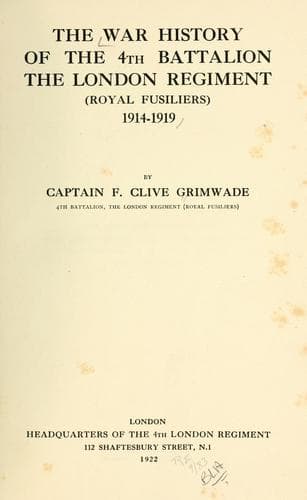
The War History of the 4th Battalion, the London Regiment (Royal Fusiliers), 1914-1919Grimwade, F. Clive
History
The War History of the 4th Battalion, the London Regiment (Royal Fusiliers), 1914-1919
Grimwade, F. Clive
Great Britain. Army. London Regiment. 4th (City of London) Battalion; World War, 1914-1918 -- Regimental histories -- Great Britain
The enemy's artillery and trench mortars showed a marked increase of
activity during the second occupation of Moated Grange, the craters,
the Duck's Bill and Pump House, coming in for most of the punishment.
The 23rd January was perhaps the most trying to the troops. During the
morning "hate" a well-placed minenwerfer completely cut off the left
platoon in the craters, the only approach to them being by way of an
exposed and little used trench, Min Street, which involved a detour
of about 3200 yards from Headquarters. Shortly after midday a second
lucky German shell lighted on a dump of medium trench mortar shells
which were lying within a few yards of a shelter occupied by several
men of the right company. A terrific explosion took place and caused
a large crater which cut off the Battalion's right flank also, but,
strange to say, without inflicting so much as a scratch on any of the
men in the vicinity. These incidents are recounted merely as instances
of the constant annoyance caused to the troops in line by the enemy's
harassing tactics, as every bit of damage caused in this way involved
extra work to the already over-burdened troops in repairing it.
On the last evening in the line, the 25th, an attempt was made by a
fighting patrol of the reserve company (C) under 2/Lieut. Ballance to
obtain an identification from the enemy. Wire-cutting shoots had taken
place for two days previously in preparation for this, and arrangements
were made to support the patrol with artillery fire as occasion
should arise. The enemy were found, however, to have made efficient
counter-preparations, and the surprise effect of the patrol having
failed, the project had to be abandoned with the loss of 1 man killed
and 2 wounded.
During this tour the Battalion sustained 1 officer casualty, 2/Lieut.
W. Quennell, wounded.
On the 26th January the Battalion was relieved by the 1/8th Middlesex
at 10.5 p.m. and withdrew to rest billets at La Gorgue, the 168th
Brigade having passed into Divisional reserve with Brigade Headquarters
at Merville.
The 168th Brigade in rest in the Merville area settled down to such
training as was possible, the ground being covered with snow. One or
two useful instructional schemes with contact aeroplanes were carried
out, but the weather conditions prevented serious outdoor work, and
the training hours were, for the most part, devoted to repolishing the
parade discipline of the Brigade. According to the usual custom of the
Battalion when opportunity offered itself, the drums beat Retreat daily
and the Regimental Quarter Guard and inlying picket mounted in the
Grande Place at La Gorgue.
Two further drafts of about 70 N.C.O.'s and men joined the Battalion in
January.
Public-domain text, read in full here on John Shaqi.
Reviews
Reviews
No reviews yet
Be the first to share your thoughts on this work.
Elsewhere in the archive
Join the Discussion
Join the discussion
Sign in to leave a comment or review.
Sign InorCreate an account