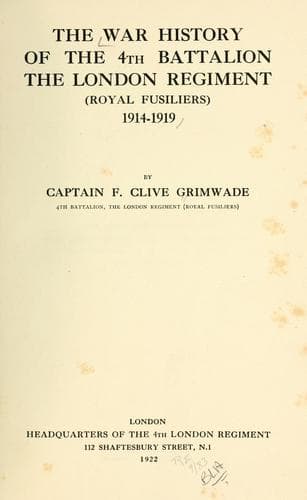
The War History of the 4th Battalion, the London Regiment (Royal Fusiliers), 1914-1919Grimwade, F. Clive
History
The War History of the 4th Battalion, the London Regiment (Royal Fusiliers), 1914-1919
Grimwade, F. Clive
Great Britain. Army. London Regiment. 4th (City of London) Battalion; World War, 1914-1918 -- Regimental histories -- Great Britain
As before the "B" line was the main line of resistance; but the great
length of the "B" line sector--some 2300 yards--which had to be held in
eight separate posts, with three additional posts at night, presented
a difficult problem in defence to one weak company of about 120
fighting ranks. The solution of the problem was not, however, actually
called for as the enemy remained unusually quiet for the whole of this
tour of duty, during which the snow fell thicker every day. After an
occupation of four uninteresting days the Battalion was relieved in
the left subsection on the afternoon of the 9th March by 1/6th Duke of
Wellington's Regiment (49th Division). On relief it withdrew to billets
at Bout Deville, marching the following morning at 8 a.m. to Merville,
where the Brigade entrained for the Le Cauroy area. Detrainment took
place at Doullens, and the Battalion marched some six miles to billets
at Le Souich, arriving shortly before midnight.
The Battalion, which had left the Somme battlefields in an exhausted
condition in the previous October, had undergone a good schooling in
the Flanders breastworks. The strength had been increased to some 850
all ranks, and all new drafts had become not only well assimilated,
but also well trained in a rather trying trench warfare. The physical
strain on the troops throughout the winter had been exceptionally
severe, owing to the terrible intensity of the winter weather, and
the very great amount of trench work for which the Battalion had
been called upon; and of this side of the incidents of the winter
sufficient has already been said for it to be realised without
difficulty that, although the Battalion still had a clean bill of
health, the prospect of a rest before embarking on active operations
was welcomed by all.
The great retirement of the Germans was now in progress, and as the
1/4th Battalion was not actively concerned in this we may turn for the
moment to follow the fortunes of the 2/4th Battalion, who had recently
arrived in France with the 58th Division and were now in action in the
Arras sector.
CHAPTER XIII
THE 2/4TH BATTALION IN FRANCE--GERMAN RETIREMENT FROM THE SOMME
The 58th Division, of which the 2/4th Londons formed a part, after
remaining at Ipswich for about a month, was transferred to the Southern
Command in hutted camps at Sutton Veny, near Warminster, on the 10th
July 1916.
Public-domain text, read in full here on John Shaqi.
Reviews
Reviews
No reviews yet
Be the first to share your thoughts on this work.
Elsewhere in the archive
Join the Discussion
Join the discussion
Sign in to leave a comment or review.
Sign InorCreate an account