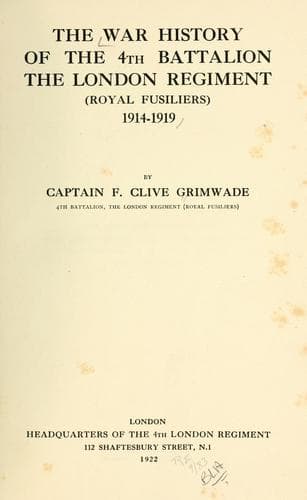
The War History of the 4th Battalion, the London Regiment (Royal Fusiliers), 1914-1919Grimwade, F. Clive
History
The War History of the 4th Battalion, the London Regiment (Royal Fusiliers), 1914-1919
Grimwade, F. Clive
Great Britain. Army. London Regiment. 4th (City of London) Battalion; World War, 1914-1918 -- Regimental histories -- Great Britain
Here the Division, being concentrated in an area which provided
excellent training facilities, had a chance to become thoroughly
welded together and to show the material of which it was made in
a manner which had hitherto been impossible, for the influence of
scattered billets is invariably and inevitably unfavourable to strict
discipline. The fullest advantage was taken of this golden opportunity,
and the resultant tightening of discipline and advancement of all
ranks in technical efficiency rapidly justified the change of station.
A very great amount of work still lay before the whole Division
before it would be fit to take its place in the line overseas, and
much reorganisation in various directions was effected with entirely
beneficial results soon after its arrival at Warminster.
Amidst all this work, which was carried out at fever-heat, the
amusement of the men was not overlooked. An excellent Divisional band
was formed, and their good services were added to early in December
by the creation of a Divisional concert troop "The Goods." Not to be
left behind in these achievements the 2/4th Londons formed their own
concert party, called for some not too obvious reason "The Tanks,"
which afforded excellent entertainments under the able direction of
2/Lieuts. T. J. Bell and C. J. Graham, who were assisted by Pipe-Major
Ling, Corpl. Wilkinson, L./Corpls. Smith, Ringrose and Hardy, and Pte.
Rosenbloom.
The 2/4th Londons had already attained a position which is believed
to be unique in the annals of the British Army inasmuch as they, a
Battalion affiliated to an English line regiment, had become the
possessors of a pipe band. This band had originally been formed for
recruiting purposes, but with the initiation of the "Derby Scheme" its
services were no longer necessary for the enticement of recruits, and
it had been secured for the Battalion. The pipers wore the Glengarry
cap and the Royal Stuart tartan. They were without doubt an exceedingly
good band and lightened many a weary mile of road both in England and
France with their stirring music.
An attempt, which originated in the 2/4th Londons, was also made to
produce a Divisional magazine, and this appeared in September under the
title of _The Direct Hit_. It was well received and attained the age of
three months, but was then discontinued.
Shortly after arrival at Sutton Veny the Division came under the
command of Major-Gen. H. D. Fanshawe, C.B., who ultimately took it to
France where he remained in command for some months.
Various changes took place in the 2/4th Londons, and in November
1916 command of the Battalion was assumed by Lieut.-Col. W. R. H.
Dann (Bedfordshire Regiment), Capt. W. A. Nunneley becoming second
in command with the temporary rank of Major. The personnel was also
strengthened by the arrival of a large officer reinforcement from the
4th (Reserve) Battalion, the majority of whom had already seen service
in France in the ranks of various London Battalions.
Public-domain text, read in full here on John Shaqi.
Reviews
Reviews
No reviews yet
Be the first to share your thoughts on this work.
Elsewhere in the archive
Join the Discussion
Join the discussion
Sign in to leave a comment or review.
Sign InorCreate an account