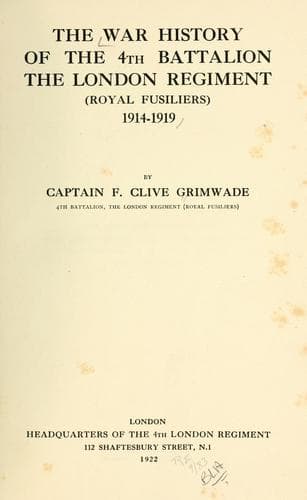
The War History of the 4th Battalion, the London Regiment (Royal Fusiliers), 1914-1919Grimwade, F. Clive
History
The War History of the 4th Battalion, the London Regiment (Royal Fusiliers), 1914-1919
Grimwade, F. Clive
Great Britain. Army. London Regiment. 4th (City of London) Battalion; World War, 1914-1918 -- Regimental histories -- Great Britain
The advancing British troops in the south this day were beginning to
threaten Puisieux, the possession of which would lay open to attack the
Bucquoy Ridge to its north. It was clear that with British forces on
the Bucquoy Ridge the German reserve lines of defence and gun positions
about Adinfer Wood (which supported the lines now opposite the 173rd
Brigade) must either retreat precipitately or run a serious risk of
being cut off. Requests for information from Brigade consequently
became more and more insistent, and information was passed to the
Battalion that the lines opposite had actually been evacuated.
Officers' patrols under 2/Lieuts. A. G. Croll, A. M. Duthie, T. J.
Bell and D. S. Boorman, which covered No Man's Land, especially in the
vicinity of the Blockhouse and the Talus on the nights of the 24th and
28th, however, elicited unmistakable signs of occupation of the German
defences. But the desultory nature of the enemy's machine-gun fire,
and of his shell fire from the direction of Adinfer Wood, the marked
decrease in the number of Véry lights put up by him at night and the
constant sounds of transport moving on the roads in rear of his lines
all provided indications that his retirement could not long be delayed.
The patrols frequently heard working parties hard at work in rear of
the enemy's lines, and it afterwards transpired that these were busily
engaged in mining the roads over which our advancing troops must pursue
the German retreat.
It had long been known that the enemy was hard at work on a highly
fortified defensive line which left his front defences at Arras and ran
in a south-easterly direction in front of Cambrai to near St Quentin.
This line, the famous "Hindenburg" line, was roughly parallel to that
now occupied by our advancing troops in the south and some eight miles
distant from it. Reports from British airmen showed that the Hindenburg
line was now the scene of feverish activity on the part of the enemy,
and this information seemed to confirm the probability indicated by the
results of our patrolling that the relinquishment of the Monchy-Arras
line was imminent.
A most unfortunate incident occurred on the night of the 28th February,
when a strong patrol under 2/Lieut. R. K. Caparn returning to our lines
was fired upon by the sentries who apparently had failed to grasp the
prearranged signal, with the regrettable result that 2/Lieut. Caparn
was very seriously wounded and L./Corpl. Warren, Ptes. Anderson and
Vickery were killed.
On the morning of the 2nd March the Battalion was relieved by the 2/2nd
Londons and withdrew to Divisional reserve in billets at Basseux and
Bailleulval. Three days' training ensued, followed by a move on the 6th
to Humbercamp.
Public-domain text, read in full here on John Shaqi.
Reviews
Reviews
No reviews yet
Be the first to share your thoughts on this work.
Elsewhere in the archive
Join the Discussion
Join the discussion
Sign in to leave a comment or review.
Sign InorCreate an account