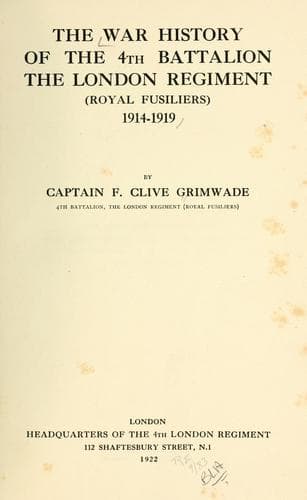
The War History of the 4th Battalion, the London Regiment (Royal Fusiliers), 1914-1919Grimwade, F. Clive
History
The War History of the 4th Battalion, the London Regiment (Royal Fusiliers), 1914-1919
Grimwade, F. Clive
Great Britain. Army. London Regiment. 4th (City of London) Battalion; World War, 1914-1918 -- Regimental histories -- Great Britain
The 173rd Brigade had now "side-stepped" to the right, and on the 7th
March the 2/4th Londons once more entered the front line, relieving
the 1/6th North Staffords in a sector known as Z1 immediately opposite
Monchy-au-Bois. Battalion Headquarters opened in Bienvillers-au-Bois.
This sector was about three miles south of that previously occupied,
and similar conditions prevailed both as regards ground and the German
retirement. No Man's Land, which was here about 300 yards wide, fell
gently from our lines to the village of Monchy-au-Bois, which had
been made a network of defences by the enemy, his first line passing
immediately in front of the village. In rear of the village the ground
again rose gently to the Adinfer Ridge.
Bienvillers was almost daily given an unpleasantly copious allowance of
gas shells which caused numerous casualties, principally to carrying
parties from Battalion Headquarters. Among these was Major Nunneley,
who was gassed on the 10th; his duties of second in command were
assumed by Capt. Spicer, the Adjutancy being filled by Capt. A. Grover
(1st Bedfordshire Regiment), who had just been transferred to the 2/4th
Battalion at the request of Lieut.-Col. Dann.
The long frost had now been succeeded by a remarkably sudden thaw which
created conditions of marked discomfort in the trenches. The water pent
up in the soil for so long filled all the trenches to a depth of about
two feet, and the trench walls everywhere began to fall in, throwing an
enormous amount of work on the occupying battalions in keeping them in
a defensible condition.
By night our patrols continued their activities, but each night on
approaching the enemy's lines were met with brisk machine-gun fire,
which showed increasing activity each day. The Battalion observers also
reported daily columns of smoke in rear of the enemy's lines, arising,
as was found subsequently, from the systematic orgy of destruction
in which the Germans indulged prior to their retirement. There was,
moreover, during these few days a very marked increase of shelling
in our back areas, the villages of Pommier, Berles, Bretencourt and
Bailleulmont all receiving an unusually large amount of heavy fire.
The 11th proved to be the most disturbed day of this tour of duty, the
enemy being exceedingly active in machine-gun and trench mortar fire.
About 100 light shells, of which many were gas, fell in Bienvillers,
fortunately without inflicting loss on the Battalion. On the 12th the
2/4th Londons were relieved by the 2/1st Londons and moved in Brigade
reserve to Pommier, where they continued training. The XVIII Corps
Commander inspected the Battalion on the 16th.
Public-domain text, read in full here on John Shaqi.
Reviews
Reviews
No reviews yet
Be the first to share your thoughts on this work.
Elsewhere in the archive
Join the Discussion
Join the discussion
Sign in to leave a comment or review.
Sign InorCreate an account