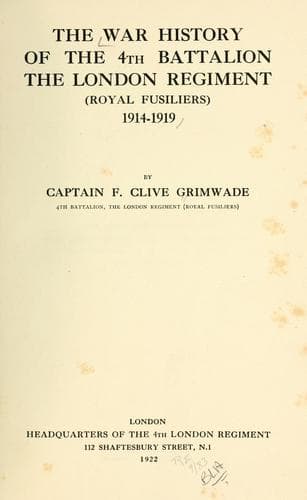
The War History of the 4th Battalion, the London Regiment (Royal Fusiliers), 1914-1919Grimwade, F. Clive
History
The War History of the 4th Battalion, the London Regiment (Royal Fusiliers), 1914-1919
Grimwade, F. Clive
Great Britain. Army. London Regiment. 4th (City of London) Battalion; World War, 1914-1918 -- Regimental histories -- Great Britain
The line held by the Brigade extended from Judas Farm near St Leger,
where it was in close touch with the Division on the right, in front of
Boyelles and Boiry-Becquerelle to the north branch of the Cojeul River.
North of the river the line was continued by the 30th Division, who
were endeavouring to force the villages of St Martin and Henin.
The Battalion had pushed outposts beyond its main line on the railway
to the Boiry-St Leger Road, but all attempts to continue the general
advance beyond this line were frustrated by the heavy machine-gun and
shell fire with which the enemy sprayed the forward slopes of the ridge
down which the advance was to be made. At the same time signs were not
wanting that his withdrawal had not reached its limit, for fires were
observed in Henin and Croisilles which indicated that the systematic
destruction which hitherto had been the prelude to his retirement was
proceeding with unabated vigour.
On the 21st the 2/4th Londons were relieved by the 2/3rd in the right
subsector and withdrew to Boiry-St Martin in reserve. For three days
the Battalion remained here under conditions of extreme discomfort. The
weather was exceptionally severe and the ground was covered with snow,
while the open and bare hillsides were swept by biting winds. Billets
were non-existent owing to the total destruction of the village, so
that the change from the front line to reserve brought very little of
rest or easier conditions. Indeed throughout this period of the advance
the terrible exposure proved a far more serious enemy than the Germans
themselves, and the casualties caused through it were five times more
numerous than those caused by wounds.
The Hindenburg line was now within measurable distance, and the salient
previously held by the enemy being almost entirely flattened out
it was found possible to withdraw several divisions now in action.
This was the more desirable not only for the provision of as many
reserve divisions as possible for the impending offensive against
the Vimy Ridge, but also for the tasks of rendering the devastated
region covered by the advance habitable to our forces, of repairing
the ruined roads, and of bringing forward the supplies of material
necessary for further operations. One of the important gains of the
advance was the reopening of direct lateral communication between Arras
and Albert. With their usual thoroughness the Germans had completely
destroyed the railway connecting these two towns, the track being torn
up and the bridges demolished; and the complete reconstruction of it
presented one of the most pressing necessities in the organisation of
the new defences.
The 58th Division, in accordance with this programme, was now
withdrawn, and on the 25th March the 173rd Brigade handed over its
sector to the 174th and withdrew to Pommier, the 2/4th Londons being
billeted at Monchy and put to work on repairing the roads.
Public-domain text, read in full here on John Shaqi.
Reviews
Reviews
No reviews yet
Be the first to share your thoughts on this work.
Elsewhere in the archive
Join the Discussion
Join the discussion
Sign in to leave a comment or review.
Sign InorCreate an account