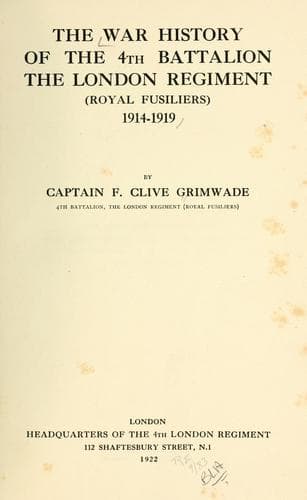
The War History of the 4th Battalion, the London Regiment (Royal Fusiliers), 1914-1919Grimwade, F. Clive
History
The War History of the 4th Battalion, the London Regiment (Royal Fusiliers), 1914-1919
Grimwade, F. Clive
Great Britain. Army. London Regiment. 4th (City of London) Battalion; World War, 1914-1918 -- Regimental histories -- Great Britain
The pursuit of the Germans was rendered exceedingly slow and arduous
by the unspeakable destruction which met our advancing columns at
every step. Cross roads had been mined and vast craters forced all
wheeled traffic to deviate on to the sodden fields adjoining. Trees
had been felled across the roads and added to the impediments to the
advance of our artillery. Everywhere the Germans had committed wanton
destruction--young fruit trees were ringed, crops were burnt wholesale,
and every sort of live stock had been driven before them in their
retreat. The aspect of the villages was most peculiar. At a distance
they appeared to be untouched, and the red roofs of the cottages showed
nothing unusual. On a closer approach, however, they were found to
be ruined and the walls knocked down so that the roofs had subsided
intact to the ground. Furniture, too heavy to be moved, had shared in
this destruction, and its débris was lying shattered among the heaps
of brick and stone. Yet further abominations had been invented, and
a series of ingenious "booby-traps" were discovered in the shape of
common articles such as shovels and helmets. These were left lying
about in places where they were likely to be picked up by our troops,
and being connected with bombs and even large mines caused explosions
when they were touched.
By noon on the 19th March the 2/1st Londons had established themselves
after some opposition from machine-gun fire on the line between
Boiry-Becquerelle and Boyelles, in touch with the 46th Division in
Hamelincourt; but further efforts to advance from this position towards
St Leger, which was the objective for the day, were effectually stopped
by heavy enemy shell and machine-gun fire.
Meanwhile the 2/4th Londons were once more moved forward, leaving
Ransart at about 3 p.m., and by 5.30 had advanced to the line of the
Boyelles-St Leger Railway on the right of the 2/1st Londons.
The 173rd Brigade now occupied the whole of the 58th Divisional
front, being in touch with the Division on its right and its left
joining the 30th Division who were facing Henin-sur-Cojeul. The line
occupied by the 2/4th and 2/1st Londons formed a marked re-entrant
in the British line, overlooking a valley which runs in a northerly
direction from St Leger to Henin-sur-Cojeul. The enemy had apparently
deployed on the further side of this valley and was holding the line
of the Henin-Croisilles Road. Opposite the right flank of the 2/4th
Londons he had for the moment considerable advantage of ground over us,
as our line was dominated by a hill which protected Croisilles from
observation. The following day the Brigade consolidated itself in this
position, Brigade Headquarters moving forward to Boiry-St Rictrude,
which was also occupied by the 2/3rd Londons in Brigade reserve, while
the 2/2nd Londons moved into close support in Boisleux-au-Mont.
Public-domain text, read in full here on John Shaqi.
Reviews
Reviews
No reviews yet
Be the first to share your thoughts on this work.
Elsewhere in the archive
Join the Discussion
Join the discussion
Sign in to leave a comment or review.
Sign InorCreate an account