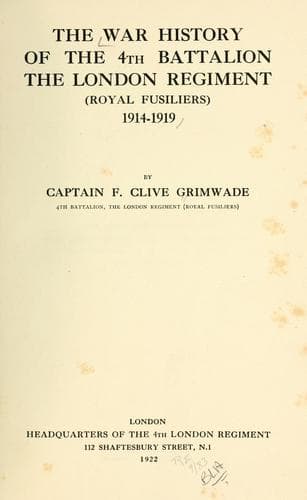
The War History of the 4th Battalion, the London Regiment (Royal Fusiliers), 1914-1919Grimwade, F. Clive
History
The War History of the 4th Battalion, the London Regiment (Royal Fusiliers), 1914-1919
Grimwade, F. Clive
Great Britain. Army. London Regiment. 4th (City of London) Battalion; World War, 1914-1918 -- Regimental histories -- Great Britain
Casualties included Major W. A. Nunneley, gassed; 2/Lieut. R. K.
Caparn, wounded; 2/Lieuts. A. M. Duthie and S. P. Ferdinando,
accidentally wounded; 2/Lieuts. H. W. Hallett and G. G. Hunt, sick; and
in N.C.O.'s and men 10 killed, 25 wounded, and about 170 sick, chiefly
from exposure.
The duties of signalling officer were taken by 2/Lieut. E. C. Pratt.
In February the Battalion was unfortunate in losing 2/Lieut. C. J.
Graham, who joined Brigade Headquarters as Intelligence Officer. He
filled this appointment with great success until March 1918, when he
was appointed Brigade Major in the 47th Division. He was decorated with
the D.S.O. and the M.C. with Bar.
CHAPTER XIV
THE 1/4TH BATTALION IN THE BATTLES OF ARRAS, 1917
Reverting now to the 1/4th Battalion, we have the task of recording its
part in the great battles of April and May 1917 which developed after
the German retirement, some account of which has been attempted in the
preceding chapter.
On transfer from the First Army area the 1/4th Battalion was billeted
at Le Souich late on the evening of the 10th March 1917. The following
day was Sunday and was observed as far as possible as a rest, and this
day the Battalion was joined by a reinforcement of officers, 2/Lieuts.
J. F. Elders, T. Caudwell, S. Minear, C. J. Reid and E. C. Hayes, all
attached from the Queen's Westminsters. On the 12th the Battalion
marched in drenching rain to Ivergny, the next village to Le Souich,
but on arrival the billets were found to be already occupied, and
orders were received to move a mile further on to Beaudricourt, which
village was reached about 4.30 p.m.
At Beaudricourt the Battalion settled down to a steady course of
company training in preparation for active operations. According to
the Battalion custom, whenever possible, the day's work was started
by Commanding Officer's parade, and the strictest attention was paid
to all points of parade discipline; while the drums beat Retreat each
evening in the village street. The training included a good deal
of route marching to harden the troops after their long sojourn in
trenches, practice attacks from trench to trench, and "specialist"
training, in the course of which every man in the Battalion received
the rudiments of instruction in the Lewis gun. The opportunity was
also taken to reorganise the companies in accordance with the then
newly-evolved scheme, which had the object of rendering the platoon
a self-contained fighting unit comprising only fighting ranks.
The four sections of the platoon were definitely organised as one
of Lewis gunners, one of riflemen, one of rifle-grenadiers and one
of bombers; and all administrative details in the company, such as
cooks, stretcher-bearers and company runners, were collected into a
"headquarter" section under the immediate supervision of the company
second in command.
Public-domain text, read in full here on John Shaqi.
Reviews
Reviews
No reviews yet
Be the first to share your thoughts on this work.
Elsewhere in the archive
Join the Discussion
Join the discussion
Sign in to leave a comment or review.
Sign InorCreate an account