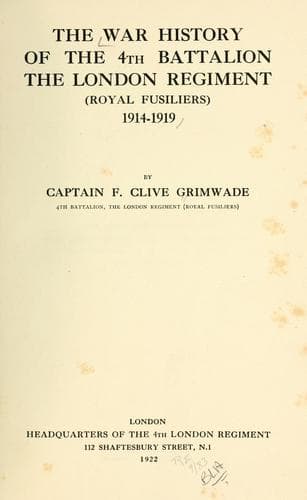
The War History of the 4th Battalion, the London Regiment (Royal Fusiliers), 1914-1919Grimwade, F. Clive
History
The War History of the 4th Battalion, the London Regiment (Royal Fusiliers), 1914-1919
Grimwade, F. Clive
Great Britain. Army. London Regiment. 4th (City of London) Battalion; World War, 1914-1918 -- Regimental histories -- Great Britain
The advantages of the new platoon organisation were evidenced by
practical demonstrations to the officers of the division of methods
of employing the various sections in co-operation with each other in
operations such as the capture of a strong point. These demonstrations
were given by a selected platoon of the Rangers, and Gen. Hull took the
opportunity of announcing to the assembled officers the rôle which it
was expected the Division would play in the coming attack.
In the latter part of March the Battalion lost three officers,
2/Lieuts. S. P. Stotter and R. W. Chamberlain to hospital, and Capt. F.
C. Grimwade seconded to VII Corps School as Instructor.
* * * * *
The intention of G.H.Q. for the offensive of 1917 was to deliver a
heavy blow against the German positions in the Scarpe-Ancre Salient
(see Map No. 9); and in conjunction with this, and in order to secure
the left flank of the attack, to wrest from the enemy his commanding
positions on the Vimy Ridge, whence excellent observation could be
obtained over the Plains of Douai. This scheme underwent considerable
modifications before it was put into operation, firstly to secure
closer co-operation with the French offensive on the Aisne; and
secondly by reason of the German Retirement of March 1917, which
altered the rôle of the Fifth Army and compelled them to re-establish
themselves in fresh positions facing the Hindenburg line.
The Hindenburg line in the vicinity of its junction with the original
German trench lines south-east of Arras being the centre of the
Battalion's operations in April and May, a reference to the map will be
of assistance to the reader in appreciating what follows. It will be
seen that the old trench systems (_i.e._ those held by the enemy until
March) crossed the valley of the Scarpe running southwards through the
eastern suburbs of Arras, as far as the Arras-Cambrai Road, and then
swinging south-westward followed the valley of the Crinchon River.
These trenches consisted of two main systems about 2000 yards apart,
the village of Beaurains being incorporated into the first system
and that of Tilloy-les-Mofflaines into the second, with Mercatel and
Neuville-Vitasse in rear of the second system. About three-quarters
of a mile south of Tilloy was Telegraph Hill, the line between being
strengthened by the enormously fortified redoubt known as The Harp.
From the southern extremity of The Harp the new Hindenburg line (or
rather system of trenches) struck off south-eastward, including
Neuville-Vitasse, crossing the valley of the Cojeul River between St
Martin and Heninel and passing thence between Croisilles and Fontaine.
Between the west side of the Cojeul valley and the Scarpe at Fampoux
was a "switch" line known as the Wancourt line, which crossed the
Cambrai Road just east of Feuchy Chapel.
The task originally allotted to the 56th Division was the capture of
Beaurains and Telegraph Hill.
* * * * *
Public-domain text, read in full here on John Shaqi.
Reviews
Reviews
No reviews yet
Be the first to share your thoughts on this work.
Elsewhere in the archive
Join the Discussion
Join the discussion
Sign in to leave a comment or review.
Sign InorCreate an account