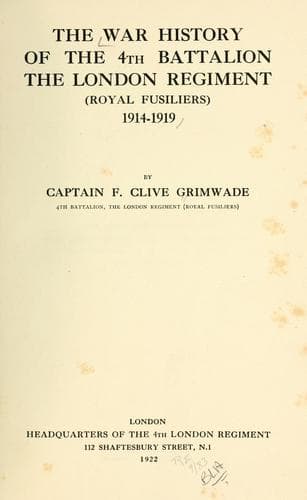
The War History of the 4th Battalion, the London Regiment (Royal Fusiliers), 1914-1919Grimwade, F. Clive
History
The War History of the 4th Battalion, the London Regiment (Royal Fusiliers), 1914-1919
Grimwade, F. Clive
Great Britain. Army. London Regiment. 4th (City of London) Battalion; World War, 1914-1918 -- Regimental histories -- Great Britain
On relief the Battalion withdrew to deep dugouts in the Cojeul Switch
about 800 yards west of Heninel. These were large and well constructed,
and accommodated the whole Battalion underground without overcrowding.
The strength of the position was enormous, and it seemed a matter for
congratulation that the British attack had succeeded in dislodging the
former occupants with comparatively so little opposition. It pointed
to the fact that no well-defined earthwork defence is in the long-run
proof against an attack delivered by well-trained troops supported by
tanks and a sufficient weight of heavy artillery; and indeed, as will
be seen later, the capture of "pillboxes" and scattered shell hole
defences proved a greater obstacle in the third Battle of Ypres later
in the summer.
The 56th Division was now withdrawn to Corps reserve; and after
spending a day in the dugouts the Battalion was relieved on the
afternoon of the 19th by the 16th Manchesters (30th Division),
withdrawing after relief to billets in Arras.
Although the opening phases of the offensive involved the Battalion
in comparatively little fighting, it had been continuously engaged in
the general rough-and-tumble of shell holes and subjected to fairly
continuous shell fire since the opening of the battle. Its losses
during this period amounted in officers to: 2/Lieut. T. Siddall,
killed; 2/Lieuts. P. Pyne and L. W. N. Jones, wounded; Rev. S. F.
Leighton Green, C.F., wounded at duty.
The battle had now completely achieved its object as originally
conceived by G.H.Q. The enemy was dislodged from the high ground on a
wide front, and the resultant change of positions afforded our troops
advantages of observation and drier foothold; and had Sir Douglas Haig
been a free agent he would at once have transferred his intentions to
the northern area, where he was desirous of launching his Messines and
Ypres offensives. In deference to the needs of our Allies, however, it
was necessary to keep the Germans active without respite on the Arras
front to which they had already drawn large reserves, and this was the
more important in view of the ghastly collapse of the Russian Empire
and the consequent liberation of enemy troops for the Western Front.
Active operations were, therefore, pursued for some time longer on the
Arras front, though perhaps they should not strictly be regarded as
part of the Battle of Arras.
After the withdrawal of the 56th Division from the line, fighting broke
out again on a wide front both sides of the Scarpe on the 23rd April,
and continued with bitterness until the 26th though with comparatively
little success. Some progress was made on both sides of the Cojeul
River, and the village of Guémappe added to the British gains.
Public-domain text, read in full here on John Shaqi.
Reviews
Reviews
No reviews yet
Be the first to share your thoughts on this work.
Elsewhere in the archive
Join the Discussion
Join the discussion
Sign in to leave a comment or review.
Sign InorCreate an account