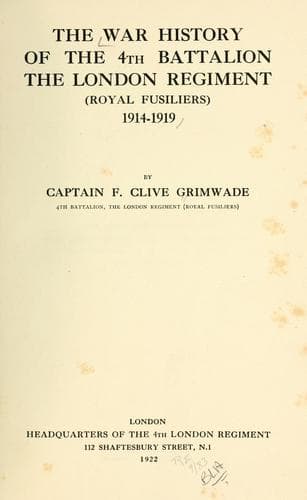
The War History of the 4th Battalion, the London Regiment (Royal Fusiliers), 1914-1919Grimwade, F. Clive
History
The War History of the 4th Battalion, the London Regiment (Royal Fusiliers), 1914-1919
Grimwade, F. Clive
Great Britain. Army. London Regiment. 4th (City of London) Battalion; World War, 1914-1918 -- Regimental histories -- Great Britain
The 15th proved to be a day of inaction, though the enemy's artillery
was continuously active over the whole Battalion area. No further
advance was attempted on the 16th and no action occurred during the
early hours of the day, with the exception of a local counter-attack
by the enemy, directed against the 50th Division on our left, in the
course of which he managed to re-establish himself on the ridge in the
vicinity of Wancourt Tower.
During the afternoon the hostile shelling slackened considerably,
but at about 4.30 p.m. warning was received that he was preparing a
counter-attack in force, and at 7.30 a barrage of terrific intensity
fell on the Battalion's trenches. The front line companies in
accordance with the prearranged scheme of defence at once cleared the
advanced trenches and pushed forward Lewis gun sections about 60
yards into No Man's Land in order to smash up any attack that might be
delivered. By this time darkness was gathering and movement becoming
hard to detect. At about 8 o'clock, however, the enemy was observed
advancing in close formation to the attack. Our Lewis guns at once
opened fire and were magnificently supported by the artillery. The
attack was completely smashed and no German reached our lines. The
enemy barrage continued without abatement for about an hour, during
which the whole Battalion area was effectively searched and a great
many casualties caused. By 9 p.m., however, the bombardment slackened,
and after a few hours of desultory shelling died out altogether.
During the evening the sector held by the London Scottish was also
subjected to severe shelling but no infantry action occurred, and it
was evident that the whole weight of the attack had fallen on the 1/4th
Londons' sector. The heaps of German dead which were visible in No
Man's Land on the following day bore striking testimony to the accuracy
of the Battalion's Lewis gun fire.
During the attack excellent work was done under heavy fire by the
medical officer, Capt. Havard, R.A.M.C., and the medical orderlies.
The Aid Post was merely a corrugated iron shed built in the side of a
sunken road and afforded no cover from the shell splinters which were
flying in all directions.
The 17th April passed without incident on the Battalion's front, though
on the left the 50th Division recaptured Wancourt Tower, the possession
of which gave us complete command of the high ground between the Cojeul
and the Sensée. That evening an inter-battalion relief took place, the
Rangers relieving the 1/4th Londons and the Kensingtons taking over
from the London Scottish. The relief of A Company had, however, to be
postponed until the following night owing to the approach of daylight.
Public-domain text, read in full here on John Shaqi.
Reviews
Reviews
No reviews yet
Be the first to share your thoughts on this work.
Elsewhere in the archive
Join the Discussion
Join the discussion
Sign in to leave a comment or review.
Sign InorCreate an account