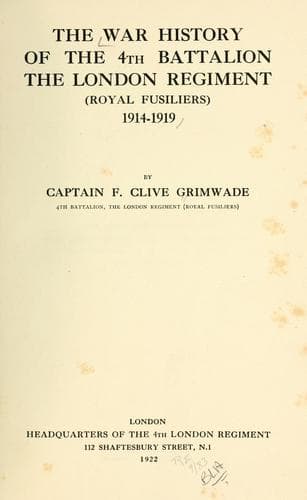
The War History of the 4th Battalion, the London Regiment (Royal Fusiliers), 1914-1919Grimwade, F. Clive
History
The War History of the 4th Battalion, the London Regiment (Royal Fusiliers), 1914-1919
Grimwade, F. Clive
Great Britain. Army. London Regiment. 4th (City of London) Battalion; World War, 1914-1918 -- Regimental histories -- Great Britain
The sector now held by the Division was about 1000 yards east of
Guémappe and Monchy-le-Preux and lay sidelong on the spurs and side
valleys descending to the Cojeul River. The enemy's defences were far
more difficult to cope with on this occasion than on the 9th April.
The Hindenburg and Wancourt lines had been passed; the Drocourt-Quéant
line was still far ahead; and the intervening area which was now
to be attacked was intersected in all directions by short isolated
trench lines in the siting of which the enemy had displayed his usual
skill in the use of ground. His defences, disposed in great depth,
were strengthened by large numbers of machine-guns cunningly placed
for mutual support in sunken roads and shell holes. It was known,
however, that the deep dugouts of the Hindenburg line did not exist in
this area, and it was hoped that a heavy and continuous bombardment
beforehand would sufficiently reduce his numbers and morale to give
success to the British infantry.
The 56th Division attack was to be carried out by the 167th and 169th
Brigades, the 168th being relegated to reserve, though available for
the assistance of either assaulting brigade as occasion might arise.
The Battalion remained in Arras until the 2nd May when, warning being
received that "zero" for the attack was fixed for 3.45 a.m., the
following day it moved at 4 p.m. to assembly in The Harp. In order to
secure close co-operation between the Brigades, 2/Lieut. O. D. Garratt
was attached to the 169th Headquarters as liaison officer.
The night of the 2nd May was fine and cold, though the early hours
were misty, and at 3.40 a.m. on the 3rd when our bombardment increased
to hurricane intensity it was still almost dark. At this hour the
Battalion stood to, and the vivid flashes of the guns and the streams
of S.O.S. signals from the enemy lines showed that inferno had broken
loose, and the attack had begun. The British barrage was good, but the
enemy was evidently expecting the attack as his counter-barrage was
quick and his machine-gun fire devastating in volume and accuracy.
The 3rd May was a day of great disappointment all along the line, and
comparatively little success was achieved. The 169th Brigade were
held up by a German strong post in Cavalry Farm and, after occupying
a precarious position between it and the river for some hours, were
forced back by a heavy counter-attack to their original line. The 167th
Brigade was also unable to progress.
Public-domain text, read in full here on John Shaqi.
Reviews
Reviews
No reviews yet
Be the first to share your thoughts on this work.
Elsewhere in the archive
Join the Discussion
Join the discussion
Sign in to leave a comment or review.
Sign InorCreate an account