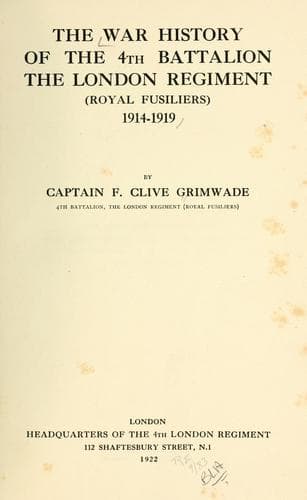
The War History of the 4th Battalion, the London Regiment (Royal Fusiliers), 1914-1919Grimwade, F. Clive
History
The War History of the 4th Battalion, the London Regiment (Royal Fusiliers), 1914-1919
Grimwade, F. Clive
Great Britain. Army. London Regiment. 4th (City of London) Battalion; World War, 1914-1918 -- Regimental histories -- Great Britain
It seems clear that zero hour was too early. In the darkness it was
impossible for the troops to see visual signals of command, and the
delay caused by having to pass messages down the line owing to the din
of the bombardment resulted in the attacking waves moving off zig-zag
in shape with officers at the advanced points. In such a formation they
became an easy target for the enemy machine-guns. Some greater success
might, moreover, have been achieved had the creeping barrage moved
forward more quickly, which would have been quite possible in view of
the comparatively unbroken state of the ground.
Early in the day the 1/4th Londons had moved forward to positions
in shell holes at Airy Corner, near Feuchy Chapel, and at 8.30 p.m.
the Battalion, now definitely at the disposal of the 169th Brigade,
received orders to advance to positions in the Wancourt line just
south of the Arras-Cambrai Road. This move was followed by another at
11 p.m., which brought the Battalion into close support of the front
line in Tank Trench, apparently in anticipation of a further German
counter-attack. The forward movement was made under a very heavy
gas shell bombardment, but gas helmets were worn and practically no
casualties were suffered. Shortly after arrival in the new position the
enemy shelling slackened, and as no further action appeared imminent
the Battalion was once more withdrawn to the Wancourt line, the move
again being made in gas helmets. A move of 8000 yards in the dark with
respirators is no easy matter to troops laden with battle equipment,
and the men were somewhat exhausted on regaining the reserve position.
A few hours' rest, however, put them to rights, and at 3 p.m. on the
4th the Battalion was again under orders to move forward. The losses
of the 167th and 169th Brigades on the previous day were so severe
that immediate relief was necessary for them, and the 168th Brigade
therefore took over the whole Divisional front; the Battalion relieving
the Queen Victorias and Queen's Westminsters in the subsector between
the Arras-Cambrai Road and the Cojeul River, with the London Scottish
on its left.
[Illustration: CAVALRY FARM, MAY 1917]
Public-domain text, read in full here on John Shaqi.
Reviews
Reviews
No reviews yet
Be the first to share your thoughts on this work.
Elsewhere in the archive
Join the Discussion
Join the discussion
Sign in to leave a comment or review.
Sign InorCreate an account