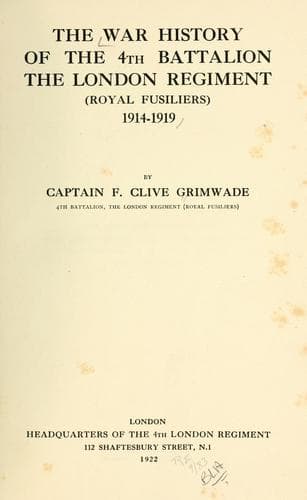
The War History of the 4th Battalion, the London Regiment (Royal Fusiliers), 1914-1919Grimwade, F. Clive
History
The War History of the 4th Battalion, the London Regiment (Royal Fusiliers), 1914-1919
Grimwade, F. Clive
Great Britain. Army. London Regiment. 4th (City of London) Battalion; World War, 1914-1918 -- Regimental histories -- Great Britain
The objectives allotted to it were Cavalry Farm and the trench
south-east of it, and Tool Trench for a frontage of 250 yards north of
the Cambrai Road; while the London Scottish were to extend the attack
on Tool Trench for a further 600 yards to the north and also capture
a small copse on the extreme left. The attack was to be made in each
battalion on a two company front, each company advancing in two waves
on a front of two platoons. One company of the Rangers was attached to
the 1/4th Londons and one of Kensingtons to the Scottish.
For two days previous to the 11th, which was fixed for the operation,
the Divisional artillery had been carrying out destructive bombardments
with 4·5-inch howitzers on the objectives as well as on the
communication trenches leading to the rear and on the portion of Tool
Trench outside the limits of attack. On the evening of the 10th a
practice 18-pr. barrage was placed on the objectives, but the enemy
reply was so efficient that it was decided to conduct the assault
without any increase in our normal artillery activity and to endeavour
to carry the operation through as a surprise.
At 8.30 p.m. on the 11th May the assaulting waves moved forward, the
1/4th Londons' attack led by D Company (H. N. Williams) on the right
of the road and A Company (Lorden) on the left, with B (Beeby) and C
(Rees) Companies in support. The surprise effect was excellent, and was
heightened by the fact that all the objectives except the Farm itself
were hidden from our trenches by a slight spur which here drops down to
the Cojeul River. The enemy had thus, in the absence of a barrage, no
warning of the attack, and in a few minutes the whole of the objectives
were captured. Few prisoners were taken, but a party of about fifty of
the enemy, fleeing from Cavalry Farm, were caught by our Lewis guns and
annihilated. Lewis gun posts were at once pushed forward into No Man's
Land, and the consolidation of the captured trench begun. So quickly
had all this happened that the enemy artillery opening in response
to an S.O.S. sent up from their lines was harmless to the leading
companies, though it inflicted some loss on the support companies which
were moving up to our vacated front line.
The consolidation of the captured position was aided by the Cheshire
Pioneers, who completed before dawn a communication trench connecting
Cavalry Trench with the new front line.
Public-domain text, read in full here on John Shaqi.
Reviews
Reviews
No reviews yet
Be the first to share your thoughts on this work.
Elsewhere in the archive
Join the Discussion
Join the discussion
Sign in to leave a comment or review.
Sign InorCreate an account