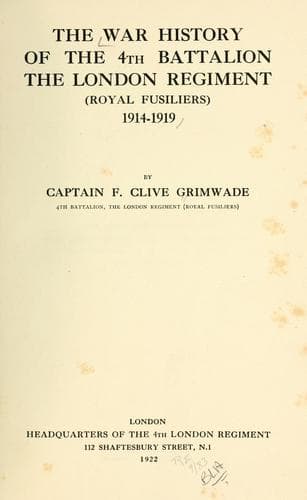
The War History of the 4th Battalion, the London Regiment (Royal Fusiliers), 1914-1919Grimwade, F. Clive
History
The War History of the 4th Battalion, the London Regiment (Royal Fusiliers), 1914-1919
Grimwade, F. Clive
Great Britain. Army. London Regiment. 4th (City of London) Battalion; World War, 1914-1918 -- Regimental histories -- Great Britain
The Battalion remained in rest for about three weeks, which were
officially occupied in training and reorganisation. The actual training
was, however, reduced to the minimum, and the Battalion's really
serious duty became that of training for Battalion and Brigade sports,
and the relaxation which these provided combined with the determination
with which all ranks strove to gain physical fitness for the purpose
of the sports was undoubtedly quite as valuable as hours spent on the
parade ground. On the 23rd the Brigade was paraded for inspection by
Gen. Hull, who presented ribands to those who had been decorated in the
recent operations.
The following day the Battalion moved from Berneville to fresh billets
in Simencourt, where the routine of training and recreation proceeded.
Early in June the 56th Division returned to the line, the 168th Brigade
moving to Montenescourt on the 11th and to Achicourt on the following
day.
Eight days later the 168th Brigade relieved the 169th in the line, the
Battalion moving into left support positions at Wancourt, where it
relieved the 1/2nd Londons. Here the Battalion remained for five days
supplying working parties chiefly in connection with the construction
of new communication trenches to connect up the recently gained advance
posts with the front line, and in connecting up the posts themselves
to form a new front line. These days passed without incident beyond a
certain amount of enemy shelling and trench mortar fire, and on the
evening of the 26th June the Battalion moved forward to relieve the
Kensingtons in the front line system, its right flank resting on the
Cojeul River, where it joined the London Scottish, and its left flank
about 800 yards north of the Arras-Cambrai Road in Hook Trench. This
relief was completed by 1.30 a.m. on the 27th, and the sector was held
with three companies in front line and one in reserve.
This tour of duty passed without important incident though the enemy's
artillery exhibited some activity, principally against the back areas
in the neighbourhood of Wancourt. On the 1st July hostile aircraft
were especially active, making many unsuccessful attempts to pass the
barrage of the British anti-aircraft batteries. This unusual anxiety of
the German airmen to cross our lines was possibly due to the presence
in the Arras area of H.M. the King, who was then visiting the troops in
France and staying at Bavencourt Château on the Arras-Doullens Road.
That evening at 11 p.m. the 6th Queens of the 12th Division took over
the portion of the Battalion's sector lying to the north of the Cambrai
Road, and the following evening the remainder of the sector was handed
over to the 5th Borders of the 50th Division, the Battalion withdrawing
on relief to billets in Achicourt, which it reached at 5 a.m. on the
3rd July.
Public-domain text, read in full here on John Shaqi.
Reviews
Reviews
No reviews yet
Be the first to share your thoughts on this work.
Elsewhere in the archive
Join the Discussion
Join the discussion
Sign in to leave a comment or review.
Sign InorCreate an account