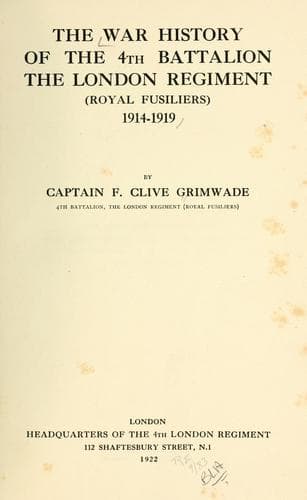
The War History of the 4th Battalion, the London Regiment (Royal Fusiliers), 1914-1919Grimwade, F. Clive
History
The War History of the 4th Battalion, the London Regiment (Royal Fusiliers), 1914-1919
Grimwade, F. Clive
Great Britain. Army. London Regiment. 4th (City of London) Battalion; World War, 1914-1918 -- Regimental histories -- Great Britain
The part of the 56th Division in the Arras fighting was now finished,
and the Division was withdrawn into Corps reserve for a welcome rest.
The fighting on the Hindenburg line was practically over, though we
shall have further reference to make to it in connection with the 2/4th
Battalion in another chapter.
The weeks of battle had placed a great strain on the Battalion. Long
marches to and from the line, shell hole bivouacs, heavy working
parties, bad weather and severe shelling had all had their effect, and
a period of rest and reorganisation was needed.
At 9.30 a.m. on the 4th July the 168th Brigade embussed for the Le
Cauroy area, in which it had trained a year previously prior to
occupying the Hébuterne trenches. The Battalion was allotted billets in
Denier where it entered on a short period of rest and reorganisation
in which the training was interspersed with the various rounds of the
Brigade boxing competition, the finals of which were held on the 15th
July.
In June Lieut. H. Jones was seconded to VI Corps School as Instructor;
Capt. V. S. Bowater was evacuated to hospital; and 2/Lieut. C. W.
Denning joined the Battalion, being posted to the 168th L.T.M. Battery
early in July; 2/Lieuts. L. W. Wreford and A. C. Knight rejoined the
Battalion in July.
The Division was now warned of an impending move to another theatre of
activity, and this move occurred on the 23rd, when the Division left
the VII Corps to join the Fifth Army in the Ypres Salient.
CHAPTER XV
THE 2/4TH BATTALION IN THE BATTLES FOR BULLECOURT, 1917
We must now follow the battles which had been fought during the latter
part of the German retirement south of the area covered by the battles
of Arras.
All along the line the German retreat had been conducted steadily and
with marked success on to the Hindenburg line. Although on the whole
the retreat in the south had not been accompanied by heavy fighting,
the attempts of our troops to push forward and define rigidly the
Hindenburg system had met with resistance which had developed here and
there into fighting of the most desperate character. Nowhere had these
local conflagrations been more fierce than in the line of retreat to
Bullecourt. In this sector the retiring enemy was opposed by Australian
troops, who together with the 7th and 62nd (and later the 58th)
Divisions composed Gough's Fifth Army.
A successful advance on 2nd April in this region was followed
by an attempt by the Australians on the 12th to carry the line
Bullecourt-Lagnicourt, but without success owing to the inadequacy
of the supporting artillery fire. Severe fighting ensued, and a
counter-attack of a serious nature by the Germans on the 15th was
ultimately held.
Public-domain text, read in full here on John Shaqi.
Reviews
Reviews
No reviews yet
Be the first to share your thoughts on this work.
Elsewhere in the archive
Join the Discussion
Join the discussion
Sign in to leave a comment or review.
Sign InorCreate an account