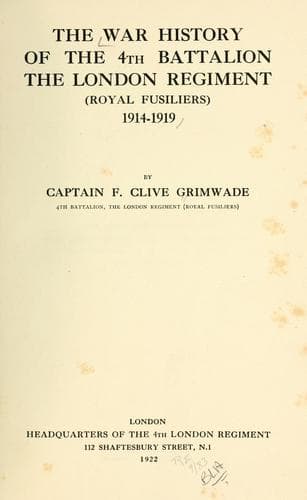
The War History of the 4th Battalion, the London Regiment (Royal Fusiliers), 1914-1919Grimwade, F. Clive
History
The War History of the 4th Battalion, the London Regiment (Royal Fusiliers), 1914-1919
Grimwade, F. Clive
Great Britain. Army. London Regiment. 4th (City of London) Battalion; World War, 1914-1918 -- Regimental histories -- Great Britain
On the 3rd May the Australians' efforts met with more success, and they
were able to penetrate the Hindenburg system on the immediate right of
Bullecourt. The 62nd Division on their left, however, were unable to
progress in the village itself, with the result that the ground held by
the Australians formed a salient badly enfiladed both from the village
and from the direction of Quéant.
The position of Bullecourt in the Hindenburg system was peculiar. From
Heninel the line ran in a generally south-easterly direction towards
Bullecourt in front of the Fontaine-lez-Croisilles-Bullecourt Road. At
Bullecourt the line turned due east, passing some 500 yards in front of
Riencourt. Bullecourt itself was between the front and support trenches
of the first system, so that the front line formed a very pronounced
salient. East of Riencourt the line once more took an abrupt turn, this
time almost due south, passing in front (or to the west) of Quéant.
Bullecourt lies on a spur which falls northward into the Hendecourt
valley, and its exits on all sides form a network of sunken roads. At
the period under review the majority of the houses were already in
ruins, and these, together with numerous fences enclosing orchards and
gardens, converted the space between the front and support Hindenburg
lines into a serious obstacle, of which the strength was increased by
an intermediate trench half-way through the village. The Germans had,
moreover, tunnelled the village in such a way that they could bring
reinforcements rapidly and safely to bear on any threatened point.
The small salient gained by the Australians straddling the Hindenburg
trenches on the immediate east of the village, uncomfortable as it
was for the occupants, was a serious menace to the enemy position;
and it was reasonable to anticipate that the Germans would not easily
acquiesce in this partial envelopment of their flank.
During the early days of May the Australians in the salient were
subjected to numerous counter-attacks, while by dint of hand-to-hand
fighting the 62nd Division had gained a firm footing in the village. On
the 12th May the assault was renewed by the 7th Division, and fighting
of a desperately severe character developed in the village in which our
troops met with varying fortunes. In the eastern half of the village
the 2nd Queen's made some progress, but at the western end no advance
was possible. The situation at the sunken cross-roads at the north-east
corner of the village was obscure, and north of this point no part of
the enemy's support line was gained. Such was the position in "Bloody
Bullecourt" when the 58th Division began to take over the line.
Public-domain text, read in full here on John Shaqi.
Reviews
Reviews
No reviews yet
Be the first to share your thoughts on this work.
Elsewhere in the archive
Join the Discussion
Join the discussion
Sign in to leave a comment or review.
Sign InorCreate an account