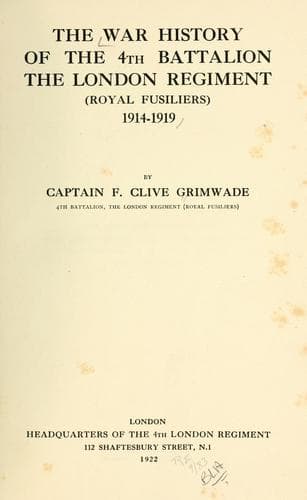
The War History of the 4th Battalion, the London Regiment (Royal Fusiliers), 1914-1919Grimwade, F. Clive
History
The War History of the 4th Battalion, the London Regiment (Royal Fusiliers), 1914-1919
Grimwade, F. Clive
Great Britain. Army. London Regiment. 4th (City of London) Battalion; World War, 1914-1918 -- Regimental histories -- Great Britain
The Germans, having been ejected from their trench system in this
sector, were holding on in a system of unconnected shell holes on the
lower slopes of the spur, and their main line of resistance appeared
to be a sunken road running laterally across our front, and distant
about 300 yards. A new and evidently unfinished trench line crossed the
opposite hillside in front of Hendecourt.
The heavy shelling which had interfered with the relief continued
throughout the night, our front and support lines being heavily
bombarded, while the back areas were subjected to incessant searching
with high explosive and shrapnel.
Shortly after the Battalion had taken up its position a party of some
12 Germans with a machine-gun attempted to attack C Company's line. The
attack completely failed owing principally to the great gallantry of
Capt. Leake. 2/Lieut. S. G. Askham, who was in the trench with Leake at
the time, writes:
We were inspecting the sentry posts and our attention was drawn
to considerable movement near our front line. Without a moment's
hesitation Capt. Leake leapt over the parapet and in a few seconds
we heard revolver shots being fired. He had single-handed attacked
a German machine-gun team who were on the point of establishing
a post in a position overlooking the whole of our front line. He
killed four of the team and the remainder were wounded by our rifle
fire. Leake returned with three prisoners and their machine-gun,
which he also secured.... Leake was a tower of strength to both
officers and men in the Company and we all felt that he richly
deserved the V.C., for which he was afterwards recommended.
The continued bombardment now began to cause difficulty in controlling
the situation, for early in the morning a direct hit on the Brigade
signal depôt completely wrecked all the instruments and killed the
occupants of the dugout. Later, communication by power buzzer was also
cut, and for the remainder of the day all communication between the
Brigade and the battalions in the line had to be effected by runners.
Public-domain text, read in full here on John Shaqi.
Reviews
Reviews
No reviews yet
Be the first to share your thoughts on this work.
Elsewhere in the archive
Join the Discussion
Join the discussion
Sign in to leave a comment or review.
Sign InorCreate an account