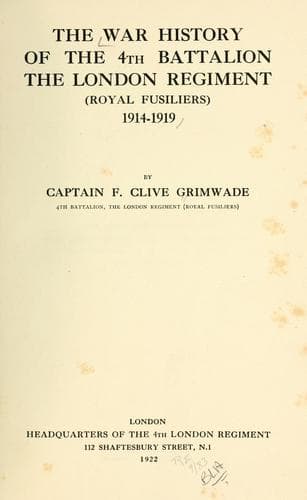
The War History of the 4th Battalion, the London Regiment (Royal Fusiliers), 1914-1919Grimwade, F. Clive
History
The War History of the 4th Battalion, the London Regiment (Royal Fusiliers), 1914-1919
Grimwade, F. Clive
Great Britain. Army. London Regiment. 4th (City of London) Battalion; World War, 1914-1918 -- Regimental histories -- Great Britain
This intermittent shelling continued until shortly after midday on the
14th, when the enemy was observed from our lines to be massing for
attack in the neighbourhood of a ruined factory some 500 yards to our
front. A call was made on our artillery, which immediately put down a
heavy barrage under which the enemy's troops melted away. The hostile
bombardment now increased in intensity and a terrific barrage came down
on our lines, continuing with unabated violence all through the night.
This barrage was for the greater part in enfilade from the direction
of Quéant, and was therefore particularly accurate and deadly; under
the rain of shells our trenches, or what little remained of them, were
completely obliterated, the greater part of our front line supplies of
rifle ammunition and bombs were blown up and several Lewis guns with
their teams were buried. Through this appalling ordeal the Battalion
stuck to their posts grimly, though suffering severe losses. Shortly
before midnight the enemy launched an attack on the 7th Division in
Bullecourt village, in which by dint of fierce hand-to-hand conflicts
they wrested from the 7th Division some of its gains of the previous
two days.
We have already pointed to the importance of the salient now occupied
by the 2/4th Londons, and, fully alive to the position, the Battalion
was not surprised by the attack which broke upon it at dawn the next
day. The importance to the Germans of the possession of this part of
the line may be gauged by the fact that the troops employed by them
were the 3rd Prussian Guard.
At 4 a.m. on the 15th the enemy were seen to be massing for the attack.
Our artillery once more responded magnificently to the call made on
them, and their barrage caused severe disorganisation in the enemy's
ranks. The attack was stubbornly pushed home by the Germans, but their
barrage being lifted prematurely from our front line an opportunity was
afforded to our leading companies to prepare for the shock. Advantage
of this momentary respite was taken to reinforce the front line, three
platoons of B Company filling the gaps of D Company, and C Company
being strengthened by a party of A Company. These precautions cost the
enemy dearly, and his assaulting columns were met by a deadly rifle and
Lewis gun fire from the whole of our line, which completed the work
of the artillery. The German attack was broken and not a single enemy
reached our line. The remnants of the assaulting battalions turned and
fled down the hill, leaving an appalling number of dead and wounded.
Beyond the right of the Brigade front a small party succeeded in
effecting a lodgment in a portion of the front line held by the
Australians, but these were shortly afterwards ejected with the
assistance of a platoon of the 2/2nd Londons.
Public-domain text, read in full here on John Shaqi.
Reviews
Reviews
No reviews yet
Be the first to share your thoughts on this work.
Elsewhere in the archive
Join the Discussion
Join the discussion
Sign in to leave a comment or review.
Sign InorCreate an account