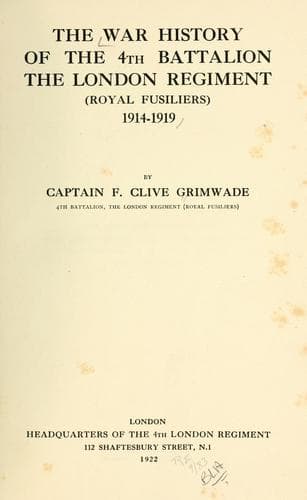
The War History of the 4th Battalion, the London Regiment (Royal Fusiliers), 1914-1919Grimwade, F. Clive
History
The War History of the 4th Battalion, the London Regiment (Royal Fusiliers), 1914-1919
Grimwade, F. Clive
Great Britain. Army. London Regiment. 4th (City of London) Battalion; World War, 1914-1918 -- Regimental histories -- Great Britain
That night at 11 p.m. the Battalion handed over to the 2/12th Londons
(175th Brigade) and marched to rest billets in Bihucourt, where it
remained until the 29th, engaged in reorganisation and refitting
and training. During this period the gaps in the Battalion were
partly filled by reinforcements of two officers, 2/Lieuts. J. H. L.
Wheatley and E. P. Higgs, and a large draft of N.C.O.'s and men. The
2/4th Londons were visited on the 20th May by Lieut.-Gen. Birdwood,
commanding the Australians, who congratulated Lieut.-Col. Dann on the
Battalion's achievement.
During the latter half of May the 58th Division extended its left
flank, taking over in succession from the 7th and 62nd Divisions both
of which had suffered severely. By the end of the month the Division
was occupying a front of 4000 yards with two brigades in line. The
173rd Brigade took over the left subsector with the 2/1st and 2/2nd
Londons in line, and the 2/3rd Londons in close support, while the
2/4th Londons moved on the 31st May in Brigade reserve to Mory, where
they continued training.
Map No. 11 shows the position at this date. It will be seen that
north-west of Bullecourt the Hindenburg line on the Divisional front
was still not captured, though on its left the 21st Division was in
possession of the front trench as far as the Croisilles-Fontaine Road.
The 58th Division sector consisted for the greater part of isolated
shell hole defences.
There thus remained in this area a length of about 2500 yards of
Hindenburg front and about 3500 yards of Hindenburg support trench
still to be captured from the enemy in order to complete the allotted
task.
The first two days in the new sector passed without incident beyond
the usual artillery activity. Early on the morning of the 3rd June a
gas attack was carried out on the enemy's lines opposite our left by a
discharge of 197 gas projectors. The gas cloud formed appeared highly
satisfactory, and evidently caused the enemy some perturbation as his
artillery promptly put a barrage on our forward posts. This, however,
inflicted but little loss owing to the previous withdrawal of the
garrisons as a precautionary measure.
Various signs of nervousness exhibited by the enemy about this time
suggested that he expected the continuance of our offensive, and indeed
in view of the successes already gained he might with reason anticipate
that he would not be left in unmolested possession of the remaining
sectors of the Hindenburg system.
Public-domain text, read in full here on John Shaqi.
Reviews
Reviews
No reviews yet
Be the first to share your thoughts on this work.
Elsewhere in the archive
Join the Discussion
Join the discussion
Sign in to leave a comment or review.
Sign InorCreate an account