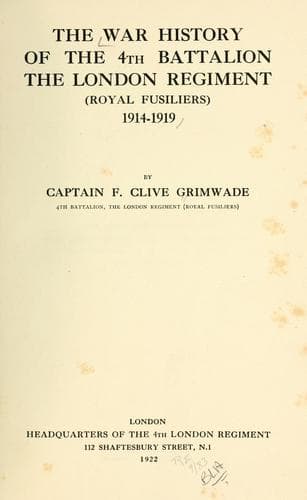
The War History of the 4th Battalion, the London Regiment (Royal Fusiliers), 1914-1919Grimwade, F. Clive
History
The War History of the 4th Battalion, the London Regiment (Royal Fusiliers), 1914-1919
Grimwade, F. Clive
Great Britain. Army. London Regiment. 4th (City of London) Battalion; World War, 1914-1918 -- Regimental histories -- Great Britain
By six o'clock the enemy counter-attack was definitely and finally
broken and small parties could be seen doubling away from before
Bullecourt; and a further attempt to launch an attack on the
Australians about half an hour later was effectively stopped by our
artillery.
After the attack had failed the enemy settled down to a slow but steady
shelling of our line for the remainder of the 15th, which was spent in
endeavouring to reorganise the battered remnants of the Battalion and
to put the lines once more in a defensible condition. Under cover of
darkness the 2/1st Londons took over the left subsector from the 2/4th
Londons, which withdrew to reserve dugouts in the sunken road in front
of Noreuil.
The Battalion had found itself. In its first serious action it had
stood up to a frightful bombardment which had lasted without abatement
for nineteen hours, and at the end of it had seen the backs of the
Prussian Guard. It had paid, however, a severe price. The total
casualties during the two days in the line were, in officers, in
addition to the two already mentioned, 2/Lieuts. E. C. Pratt and T.
Stoaling (killed); Capts. G. E. A. Leake and H. C. Long (wounded); and
in N.C.O.'s and men 68 killed, 196 wounded and 2 missing.
Capt. Leake had behaved with the utmost gallantry throughout the
attack. He was hit after the attack itself was over by a shell which
fell on his Company Headquarters, wounding also his second in command,
Capt. Long, and several of his Company staff. While being conveyed on
a stretcher to the Aid Post, Leake was again severely hit by a shell
which burst almost under the stretcher, killing two of the bearers.
After the shelling had subsided he was evacuated, but died in hospital
a fortnight later. For his magnificent behaviour he was recommended by
Lieut.-Col. Dann for the Victoria Cross, and eventually was awarded
the D.S.O. a few days before his death. This was conferred on him by
Gen. Gough, who visited for the express purpose the C.C.S. in which
Leake was lying. Lieut.-Col. Dann was awarded the D.S.O. for his
excellent work in this action. Awards of the Military Medal were made
to L./Corpls. Spencer and Selby, and Ptes. Grierson, Olinski and Spence.
For three days the Battalion remained in the sunken road supplying
carrying parties to the front line. The destruction caused by the
hostile bombardment was such that all the necessary trench supplies in
munitions and material had to be completely renewed, and, moreover, the
battalion in the line was dependent on its supporting troops for their
water supply. This imposed a very heavy strain on the 2/4th Battalion
for the back areas were still continuously shelled, largely with gas
shell, and particularly during the hours of darkness when the carrying
parties were at work; and the relief of the 173rd Brigade by the 175th
which ensued on the night of the 18th/19th May was welcome.
Public-domain text, read in full here on John Shaqi.
Reviews
Reviews
No reviews yet
Be the first to share your thoughts on this work.
Elsewhere in the archive
Join the Discussion
Join the discussion
Sign in to leave a comment or review.
Sign InorCreate an account