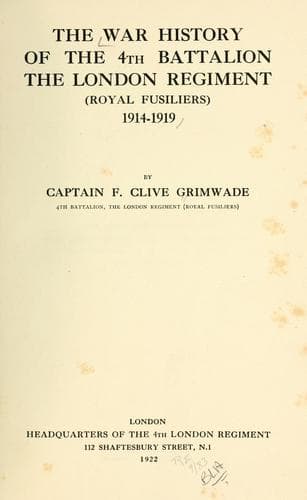
The War History of the 4th Battalion, the London Regiment (Royal Fusiliers), 1914-1919Grimwade, F. Clive
History
The War History of the 4th Battalion, the London Regiment (Royal Fusiliers), 1914-1919
Grimwade, F. Clive
Great Britain. Army. London Regiment. 4th (City of London) Battalion; World War, 1914-1918 -- Regimental histories -- Great Britain
The troops detailed for the attack were in order from right to left,
1 company 2/3rd, 1 company 2/1st, 1½ companies 2/2nd and 1 company
2/4th Londons. For the purposes of the operation the companies of the
2/3rd and 2/4th Londons were respectively under command of the officers
commanding 2/1st and 2/2nd Londons. The attack was to be delivered
under a heavy barrage from a strong concentration of guns of the
7th, 58th and 62nd Divisions and the Corps Heavy Artillery, together
with the massed guns of the three Brigade Machine-Gun Companies.
Arrangements were also made for the provision of supporting rifle,
Lewis gun and machine-gun fire by the 21st Division.
The 174th Brigade was to arrange for the establishment of a line of
posts along the sunken road in prolongation to the right of the 173rd
Brigade's objective.
A Company (Cotton) was detailed for the first day's attack, and the
special task allotted to it by Lieut.-Col. Richardson, commanding the
2/2nd Battalion, was the capture of the sunken cross-roads to the left
of the Hump and of a German strong point in the front line about 100
yards north of them.
The assembly was successfully carried out during the night of 14th/15th
June, and completed by about 2.15 a.m. At 2.50 a.m. our barrage opened
and the assaulting waves moved forward to the attack in good order,
keeping well up to the barrage and suffering very little loss.
The attack proved successful though it led to some hard fighting. The
actual advance was entrusted to two platoons under 2/Lieut. Wheatley
(right) and 2/Lieut. Bell (left). The objective at this point was
strengthened by two "pillbox" machine-gun posts and was in line with
the trench already held on our left by the 21st Division, from which it
was divided by a double barricade; and Lieut.-Col. Richardson took up
his Battle Headquarters in a dugout in their line, as did also Capt.
Cotton. A third platoon of A Company under 2/Lieut. Boorman assembled
in the 21st Division trench, and was formed as a bombing party with
others to rush the double barricade at zero hour and to bomb the enemy
out of their two pillboxes before our barrage had lifted off the enemy
trench in order to clear it before the arrival of Bell and Wheatley
with their platoons. A good many casualties were therefore inevitably
caused to Boorman's platoon by our own shell fire, and he reached the
traverse next to the first pillbox with only two corporals, Sherwood
and Whitworth. Here the two N.C.O.'s threw bombs, which landed neatly
outside the two doors of the pillbox, and directly they exploded
Boorman dashed round the traverse with a bomb in each hand. Sheltering
himself against the wall, he threw his bombs into each door of the
pillbox before the Germans inside had recovered from the effects of
Sherwood and Whitworth's attack. This neat piece of work secured the
pillbox to us, but before Boorman could reorganise his party for the
further advance to the second pillbox Bell's platoon had occupied the
Public-domain text, read in full here on John Shaqi.
Reviews
Reviews
No reviews yet
Be the first to share your thoughts on this work.
Elsewhere in the archive
Join the Discussion
Join the discussion
Sign in to leave a comment or review.
Sign InorCreate an account