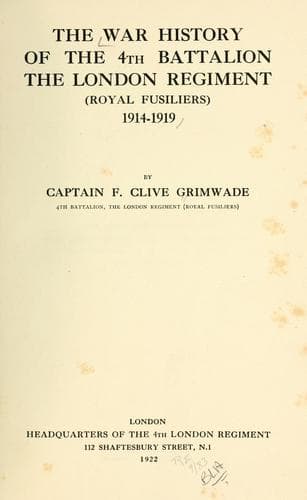
The War History of the 4th Battalion, the London Regiment (Royal Fusiliers), 1914-1919Grimwade, F. Clive
History
The War History of the 4th Battalion, the London Regiment (Royal Fusiliers), 1914-1919
Grimwade, F. Clive
Great Britain. Army. London Regiment. 4th (City of London) Battalion; World War, 1914-1918 -- Regimental histories -- Great Britain
trench. A few men of Wheatley's platoon were also found to be in line.
The greater number, including Wheatley himself, apparently overshot the
objective, not recognising it in its battered condition, and must all
have been killed or captured.
According to the prearranged scheme, Bell's platoon was withdrawn
shortly before dawn, and Boorman was left in charge of the captured
position with the remains of his own and Wheatley's platoons. The 2/2nd
Londons were now in touch on our right, and by arrangement with them
the trench was divided between the two Battalions, the 2/4th Londons
being responsible from the 21st Division on the left as far as the
communication trench running back from the Hump to the German support
line. The shelling now resumed more moderate proportions, although it
continued sporadically all day, and casualties were continually being
caused in our ranks. The Battalion suffered a severe loss early in the
day in Sergt. Riley, who was acting C.S.M. for the attack. He had done
very good work indeed ever since the Battalion had been in France,
and had throughout shown complete indifference to danger. He was shot
through the chest while accompanying Boorman on a reconnaissance to
endeavour to trace Wheatley's missing platoon.
In the meantime arrangements had been made for the further attack on
the support Hindenburg line on the following morning, and detailed
orders had been issued which provided for the assembly of the
assaulting troops in the front line--the first day's objective--by 2.10
a.m. on the 16th June. This intention could not, however, be carried
out, for at about 10.30 p.m. on the 15th a heavy counter-attack was
launched against our new positions which caused severe fighting, in the
course of which the enemy once more gained a hold on the centre of his
old front line and also at two other points.
On the front held by the 2/4th Londons the counter-offensive took the
form of a bombing attack, the approach of which along the communication
trench opposite the right of our sector was disclosed by the enemy's
own star shells, which rendered plainly visible the forms of the
attackers waist high above the battered sides of the trench. A shower
of Véry lights was at once put up, and with the assistance of these the
attack was driven off by Lewis gun and rifle grenade fire, arrangements
for which had been made most skilfully by Boorman earlier in the day.
None of the enemy succeeded in penetrating our position, but many of
his dead were left on the ground.
Public-domain text, read in full here on John Shaqi.
Reviews
Reviews
No reviews yet
Be the first to share your thoughts on this work.
Elsewhere in the archive
Join the Discussion
Join the discussion
Sign in to leave a comment or review.
Sign InorCreate an account