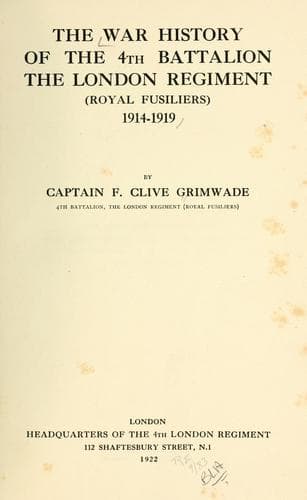
The War History of the 4th Battalion, the London Regiment (Royal Fusiliers), 1914-1919Grimwade, F. Clive
History
The War History of the 4th Battalion, the London Regiment (Royal Fusiliers), 1914-1919
Grimwade, F. Clive
Great Britain. Army. London Regiment. 4th (City of London) Battalion; World War, 1914-1918 -- Regimental histories -- Great Britain
It was, however, so essential to our purpose that the enemy should not
have the advantage of a day's respite before the attack on the support
line, that immediate arrangements were made for a counter-attack to
eject him once more from his old front line in order to leave this
clear as our jumping-off point. The recapture of the line was entrusted
to the 2/1st and 2/3rd Londons, who succeeded by surprise in completely
recovering the whole of the front line at the point of the bayonet by
2.45 a.m. on the 16th.
At 3.10 a.m. the second day's attack opened. The order of battle was
the same as for the first day, but the forces employed were larger,
the 2/3rd Londons supplying three companies, the 2/1st Londons three
companies, the 2/2nd Londons two companies and the 2/4th Londons two
companies (B under Bottomley and D under Parker).
The attack, as for the first day, was made under a creeping barrage
supplied by the Divisional artillery and the Brigade machine-gun
companies, and the assault was made in one wave with a "mopping-up"
wave in rear accompanied by a detachment of Royal Engineers for
consolidation work.
This day again a good deal of difficulty seems to have been experienced
by the advancing troops in identifying their objectives, which had
become almost entirely obliterated by our long-continued bombardments,
while the dust raised by the barrage rendered the recognition of
surrounding physical features almost impossible. The resistance of the
enemy all along the line was most stubborn, and the unusual strength
in which he was holding the attacked position clearly indicated that
the attack was expected. The earliest reports which were received by
runner led to the belief that the objective on the two flanks had
been captured. No information from the centre was forthcoming, and it
gradually became evident that the direction of the flank companies was
at fault, with the result that they had swung outwards leaving in the
centre a gap still occupied by the Germans, who promptly began to bomb
along the line against our unprotected flanks. The attack of the 21st
Division on the left, moreover, failed throughout, and although a few
isolated parties succeeded in reaching a line of shell holes in front
of Tunnel Trench they were eventually forced to withdraw.
The orders issued to the assaulting wave were to capture the Hindenburg
support line and hold on to it until supports should reach them,
but all the attempts of Lieut.-Col. Richardson to push forward his
supporting troops were frustrated by the intense rifle and machine-gun
fire with which the ground was continuously swept, and similar efforts
along the remainder of the front were stopped for the same reason.
Public-domain text, read in full here on John Shaqi.
Reviews
Reviews
No reviews yet
Be the first to share your thoughts on this work.
Elsewhere in the archive
Join the Discussion
Join the discussion
Sign in to leave a comment or review.
Sign InorCreate an account