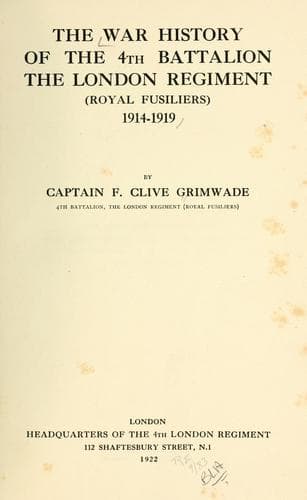
The War History of the 4th Battalion, the London Regiment (Royal Fusiliers), 1914-1919Grimwade, F. Clive
History
The War History of the 4th Battalion, the London Regiment (Royal Fusiliers), 1914-1919
Grimwade, F. Clive
Great Britain. Army. London Regiment. 4th (City of London) Battalion; World War, 1914-1918 -- Regimental histories -- Great Britain
A similar fate appears to have overtaken the remainder of B and D
Companies, and the probability is that having overshot their objective
they were outflanked and cut off by parties of the enemy coming down
the sunken road from Fontaine-lez-Croisilles. Their mistake having
become evident to them, they endeavoured, like McDowell, to fight their
way back, but after making a gallant stand were eventually killed or
taken prisoners almost to a man. It is believed from aeroplane reports
subsequently received that this gallant little body actually succeeded
in maintaining themselves against all attacks for nearly two days. But
all efforts to relieve them meeting with failure, they at last fell
gloriously rather than surrender.
A similar lack of success attended the efforts of the other battalions,
and as a result of the two days' fighting the Brigade held the front
Hindenburg line and the sunken road in rear of it, from the junction
with the 21st Division on the left to a point some 300 yards west of
the Crucifix cross-roads at Bullecourt.
The casualties of the Brigade amounted to 48 officers and 955 other
ranks, those of the 2/4th Battalion for the two days' fighting being:
Capts. E. W. Bottomley and W. H. Parker, 2/Lieuts. S. M. Williams
and J. H. L. Wheatley, killed; Capt. E. N. Cotton and 2/Lieut.
T. J. Bell, wounded; 2/Lieuts. E. A. Monkman and R. McDowell,
wounded and missing, and 2/Lieut. E. A. Stevenson, missing.
In N.C.O.'s and men the losses totalled 7 killed, 53 wounded and
139 missing, the majority being in B and D Companies.
It became evident during the afternoon that the 173rd Brigade, who were
weak before they went into action, would need relief that night, and
arrangements were therefore made for the 174th Brigade to take over the
line. In accordance with this arrangement the whole Brigade front was
taken over on the night 16th/17th June by the 2/5th Londons, who pushed
forward strong patrols towards the Hindenburg support line. This,
however, was found to be held in strength by the enemy.
With this somewhat disastrous day the idea of immediate further
offensive operations was postponed, and the 174th Brigade settled down
to consolidate itself in the Hindenburg front line.
The fighting spirit displayed throughout the operation was splendid,
and it is only to be regretted that the two days' work had not been
arranged for a one day battle. As the event showed, the capture of the
Hindenburg front line on the 15th prepared the enemy for our attempt to
take the support line on the 16th, with the result that on the second
day severe casualties were inflicted on our troops to no purpose.
During the second action at Bullecourt an incident occurred which is
surely one of the most remarkable of the whole War. We recount it in
the words of the official record, which appeared in the Battalion War
Diary on the 8th August:
Public-domain text, read in full here on John Shaqi.
Reviews
Reviews
No reviews yet
Be the first to share your thoughts on this work.
Elsewhere in the archive
Join the Discussion
Join the discussion
Sign in to leave a comment or review.
Sign InorCreate an account