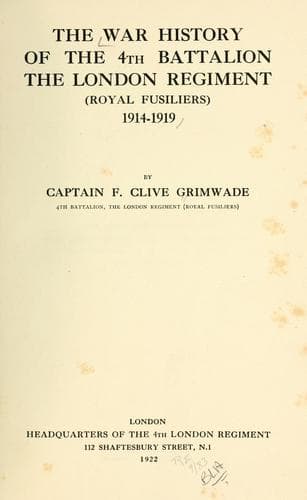
The War History of the 4th Battalion, the London Regiment (Royal Fusiliers), 1914-1919Grimwade, F. Clive
History
The War History of the 4th Battalion, the London Regiment (Royal Fusiliers), 1914-1919
Grimwade, F. Clive
Great Britain. Army. London Regiment. 4th (City of London) Battalion; World War, 1914-1918 -- Regimental histories -- Great Britain
No. 282496 Pte. Taylor J., of A Company, admitted to 29th C.C.S.
This man had been missing since Bullecourt on the 15th June 1917,
had been wounded and crawled into a shell hole. He sustained a
compound fracture of the left thigh, and aided by Pte. Peters,
B Company, had lived on bully beef found on the bodies of dead
men. After being in the shell hole for over six weeks Pte. Peters
apparently was captured, for the following day three Germans
visited the shell hole and shook Pte. Taylor's leg, but he feigned
death. The following day, not being able to obtain any food, he
decided to crawl back to our lines. His position was some distance
behind the German line. He dragged himself to the parapet of the
trench, threw himself over, crawled through the wire across No
Man's Land into the sector held by the S. Staffords. Altogether he
spent seven weeks and four days behind the German lines.
[Illustration: BULLECOURT, MAY-JUNE, 1917]
Pte. Taylor's story was subjected to severe scrutiny by Lieut.-Col.
Dann and by the Brigadier, and their opinion of its truth is witnessed
by the fact that he was awarded the D.C. Medal. Pte. Peters' fate is
unknown, and it is regrettable that after his devotion to his comrade
it was not possible to make him a posthumous award for his gallantry.
On relief by the 2/5th Londons the 2/4th Battalion marched to
Divisional reserve camp in Mory Copse, where it remained for four days
in reorganising and training. The month at Bullecourt had cost the
Battalion 597 casualties in all ranks, and a rest after the prolonged
operations was urgently needed.
B and D Companies were for the moment practically effaced, and the
few remaining details were therefore attached respectively to A and C
Companies, these two composite companies being placed under command of
Capts. E. N. Cotton and H. A. T. Hewlett.
On the 24th June the 58th Division was finally withdrawn from
Bullecourt, its place being taken by the 7th Division, and Divisional
Headquarters opened at Courcelles on that day.
The 2/4th Londons with the remainder of the 173rd Brigade had moved on
the 21st to Camp at Logeast Wood, where a welcome fifteen days' rest
was spent in training and reorganising, working parties being supplied
daily to the R.E. dump at Achiet-le-Grand.
Public-domain text, read in full here on John Shaqi.
Reviews
Reviews
No reviews yet
Be the first to share your thoughts on this work.
Elsewhere in the archive
Join the Discussion
Join the discussion
Sign in to leave a comment or review.
Sign InorCreate an account