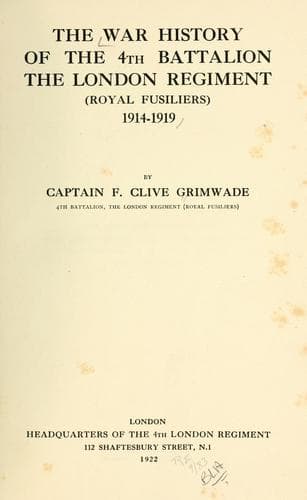
The War History of the 4th Battalion, the London Regiment (Royal Fusiliers), 1914-1919Grimwade, F. Clive
History
The War History of the 4th Battalion, the London Regiment (Royal Fusiliers), 1914-1919
Grimwade, F. Clive
Great Britain. Army. London Regiment. 4th (City of London) Battalion; World War, 1914-1918 -- Regimental histories -- Great Britain
At 3.15 a.m. on the 16th August companies began to form up on the tape
lines, the assembly being completed by 4.20 a.m., when the troops were
lying down in the open under a continuous and fairly heavy shell fire
and a galling machine-gun fire from the direction of Inverness Copse.
About 22 casualties occurred under this fire before zero hour at 5.45
a.m. The order of battle was as follows: A. Company (Spiers) on the
right and B Company (Stanbridge) on the left in front; with D Company
(H. N. Williams) on the right and C Company (Rees) on the left in
support.
The attack was to be delivered along the whole battle front at 5.45
a.m. under cover of a creeping barrage, supported by machine-gun
barrage and heavy gun fire on the enemy back areas. At zero hour the
British barrage came down, well distributed and of terrific intensity.
It was hoped that the danger points in Inverness Copse would be put
out of action by our artillery, so that the task of the 7th Bedfords
would be an easy one, but calculations in this respect were soon found
to have been mistaken. The leading companies of the 1/4th Londons got
away from the mark at zero, in good order and well up to the barrage,
but almost immediately came under a hail of lead from Inverness Copse.
The attack of the 7th Bedfords, of such vital importance to the success
of the whole operation, had failed. The artillery fire had not produced
the expected effect on the enormously strong enemy posts over which the
barrage had passed harmlessly, and the 7th Bedfords were repulsed with
loss, thereby leaving the 1/4th Londons completely exposed to the full
force of the enemy's nest of machine-guns on their right flank.
Within a few minutes 5 officers and 40 N.C.O.'s and men of A and B
Companies were casualties, but the survivors pushed forward steadily,
though a certain amount of delay caused by the gaps so suddenly torn in
their ranks was inevitable. The gallantry displayed by all ranks under
this devastating machine-gun fire, to which was added enemy shell fire
of great intensity, was unsurpassed, but under such a storm of bullets
at close range nothing could live, and the Battalion was brought to a
standstill about 200 yards from starting-point, in an old German trench
which skirted a ruined farmhouse about midway between Inverness Copse
and Glencorse Wood.
A party of some 60 men of all companies managed to gain shelter in
Jap Avenue. Here they were organised by 2/Lieut. H. E. Jackman,
under whom a strong post was consolidated and an attempt made to
push forward along the trench. This proved unsuccessful owing to the
continued intensity of the enemy machine-gun fire and the accuracy of
his sniping. Further attempts by other companies to advance were also
fruitless, and the Battalion was forced to content itself with hanging
on to these small gains, from which at intervals it was able to engage
with Lewis gun and rifle fire small bodies of the enemy in the open
near the east end of Glencorse Wood.
Public-domain text, read in full here on John Shaqi.
Reviews
Reviews
No reviews yet
Be the first to share your thoughts on this work.
Elsewhere in the archive
Join the Discussion
Join the discussion
Sign in to leave a comment or review.
Sign InorCreate an account