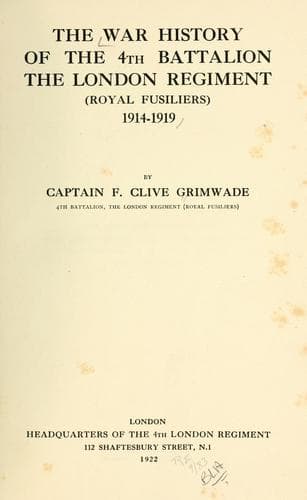
The War History of the 4th Battalion, the London Regiment (Royal Fusiliers), 1914-1919Grimwade, F. Clive
History
The War History of the 4th Battalion, the London Regiment (Royal Fusiliers), 1914-1919
Grimwade, F. Clive
Great Britain. Army. London Regiment. 4th (City of London) Battalion; World War, 1914-1918 -- Regimental histories -- Great Britain
At seven that night the Battalion moved forward from Dickebusch to
Château Segard, the move being completed by 11 p.m. Shortly after dawn
on the 15th the forward move was continued to Railway Dugouts, in the
cutting between Shrapnel Corner and Zillebeeke Lake, and here the
Battalion remained during the day.
The 15th August was occupied in issuing battle equipment and rations
to the companies, while Lieut.-Col. Marchment took the opportunity of
conducting a reconnaissance of the forward area and communications,
and of issuing his operation orders. These were explained to company
commanders as adequately as time permitted, but it must be borne
in mind that when the Battalion moved forward to the assault the
following morning no company or platoon officer had been able to see
the ground over which he was to lead his men. At 6.30 p.m. the 1/4th
Londons left Railway Dugouts in battle order for the assembly area at
Clapham Junction with guides supplied from the 53rd Brigade. A great
deal of heavy shelling, in which four men of B Company were hit, was
experienced during the advance, and in breasting a ridge near Sanctuary
Wood the Battalion had to pass through a barrage put down by the
Germans. Aided by the excellent discipline of the troops, however,
company commanders were able to split up their companies within a
few seconds, and no loss was sustained. By ten o'clock the Battalion
was concentrated with A, B and C Companies in the tunnel under the
Menin Road, and D Company in the trench south of the road. Battalion
Headquarters and part of C Company were in the trench on the north side
of the tunnel. There was no defined line of trenches in this area, the
front being held by isolated shell hole posts, and the assembly was to
be made on tape lines laid down under staff arrangements. The lack of
shelter thus made it necessary to keep the Battalion under such cover
as was obtainable till the last possible moment. During the evening an
officer of each company reconnoitred the route from the concentration
area to the tape lines, assistance being rendered by the 6th Royal
Berkshires, and No Man's Land in front of the line of assembly was
patrolled until shortly before zero hour.
The intention was to advance in a practically due east direction, while
at stated points in the line of advance platoons would halt one by one,
each establishing itself in a strong point, until finally, when the
last platoon reached its halting point, the whole Battalion would be
deployed in a line of outposts, all of which would turn to their right
and face south. This advance, being made on a front of two companies,
would result in a double line of posts of which the left flank would
rest on Black Watch Corner in touch with the 169th Brigade, while the
right flank would join hands with the 7th Bedfords in the corner of
Inverness Copse.
Public-domain text, read in full here on John Shaqi.
Reviews
Reviews
No reviews yet
Be the first to share your thoughts on this work.
Elsewhere in the archive
Join the Discussion
Join the discussion
Sign in to leave a comment or review.
Sign InorCreate an account