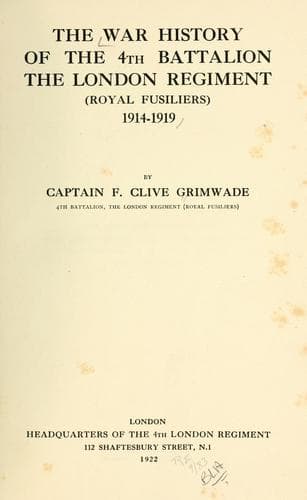
The War History of the 4th Battalion, the London Regiment (Royal Fusiliers), 1914-1919Grimwade, F. Clive
History
The War History of the 4th Battalion, the London Regiment (Royal Fusiliers), 1914-1919
Grimwade, F. Clive
Great Britain. Army. London Regiment. 4th (City of London) Battalion; World War, 1914-1918 -- Regimental histories -- Great Britain
2/Lieut. H. E. Jackman was awarded the M.C. for his excellent work and
devotion to duty this day.
Throughout the Division casualties were heavy and 6 commanding officers
and nearly 4000 all ranks fell on this unfortunate day.
On the remainder of the battle front varying success was obtained. In
the north a considerable advance was made and the German third line
was broken on a wide front. The French attack on the extreme left was
crowned with complete success. In the southern area, however, the enemy
resistance was everywhere more stubborn, and south of St Julien the
line remained unchanged as a result of the day's fighting. The Division
being concentrated in the Ouderdom area remained there training and
reorganising for several days.
On the 22nd August its move to the Eperlecques area began, and on the
24th the 1/4th Londons entrained at Reninghelst siding for Watten,
where it detrained and marched to Houlle.
[Illustration: _Inverness Copse_]
The 56th Division had been so badly handled on the 16th August that
its return to the battle area without considerable reinforcement was
out of the question and it was, therefore, moved from the Ypres area
to Bapaume. The Battalion accordingly entrained at Arques in the early
hours of the 30th August and arrived in huts in the Beaulencourt area
at 8 p.m. the same day.
CHAPTER XVII
THE THIRD BATTLE OF YPRES
II. _The 2/4th Battalion on the Northern Ridges_
After the restricted success of the 16th August, the renewal of
operations on a large scale was inevitably postponed for some time
through the continuance of adverse weather conditions; though in
the north minor operations had the effect of widening and deepening
the breach in the German defences in the neighbourhood of St
Julien, combined with the capture of a good many prisoners. These
local advances carried the British positions forward east of the
St Julien-Poelcapelle Road and gave them a firm footing in the
Gheluvelt-Langemarck line on both sides of the Ypres-Staden Railway.
The withdrawal of some of the divisions which had been engaged in the
battle since the end of July being now necessary, the 58th Division was
among the fresh divisions which were sent north to take part in the
next large attack.
On the 24th August the 2/4th Londons marched from Izel-les-Hameau
to Aubigny entraining for Hopoutre (Poperinghe), whence it marched
to quarters in Dirty Bucket Camp, one of a series of camps near
Vlamertinghe. The Division now became attached to the XVIII Corps
(Maxse). The Battalion continued its training in the new area, paying
a good deal of attention to intensive digging and musketry, and during
the days spent in Dirty Bucket the company commanders and seconds in
command attended a course of instruction at the XVIII Corps School at
Volckeringhove.
Public-domain text, read in full here on John Shaqi.
Reviews
Reviews
No reviews yet
Be the first to share your thoughts on this work.
Elsewhere in the archive
Join the Discussion
Join the discussion
Sign in to leave a comment or review.
Sign InorCreate an account