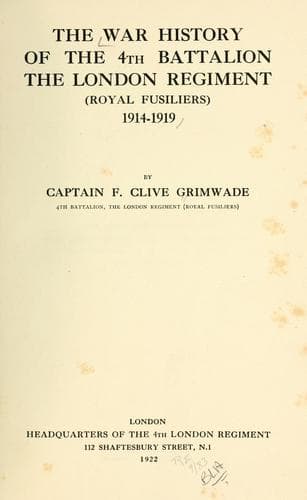
The War History of the 4th Battalion, the London Regiment (Royal Fusiliers), 1914-1919Grimwade, F. Clive
History
The War History of the 4th Battalion, the London Regiment (Royal Fusiliers), 1914-1919
Grimwade, F. Clive
Great Britain. Army. London Regiment. 4th (City of London) Battalion; World War, 1914-1918 -- Regimental histories -- Great Britain
On the night of the 28th/29th August the 58th Division entered the
trenches, taking over with the 174th and 175th Brigades, the sector
occupied by the 48th Division east of St Julien, the frontage extending
from the Hanebeek on the right to the vicinity of Keerselare on the
left. The sector was lightly held with one battalion of each brigade in
the outpost line, one battalion on the Canal Bank and two in camps west
of the Yser Canal.
The 173rd Brigade remained in Divisional reserve and continued
training. The 2/4th Londons changed station on the last day of
the month, moving to Browne Camp, about four miles north-east of
Poperinghe. Here a further week's training was obtained, after which
the whole of B Company spent four days at the Fifth Army Musketry Camp
near St Omer. Nothing worthy of record occurred during this period
except on the 1st September, when the transport lines were heavily
shelled causing casualties to 26 N.C.O.'s and men, of whom 1 died of
wounds, and to 13 horses, 8 being killed.
Reinforcements at this period included 2/Lieut. A. C. Knight (4th
Londons) and 2/Lieut. W. D. Warren (19th Londons), and about 110
N.C.O.'s and men.
On the 9th September the 2/4th Londons moved forward to Reigersburg
Camp, between Brielen and the Canal, and on the 11th-13th August the
173rd Brigade took over the whole Divisional sector.
A warning order had now been issued as to the next attack which in
view of the markedly improved conditions of weather had been arranged
for the 20th September. The front of attack was more extended than on
the 16th August, the southern limit being the Ypres-Comines Canal near
Hollebeke, and the Ypres-Staden Railway north of Langemarck marking the
northern extremity.
The success which had attended the enemy's resistance to our efforts
to advance in the Menin Road region had pointed to the necessity of
modifying the methods of attack. The successes obtained by the British
Army on the Somme, at Arras and at Messines, had caused the Germans to
alter their mode of defence, and instead of a strongly held trench line
they now presented to our attacks a system of concreted machine-gun
posts ("pillboxes" "or Mebus") disposed in great depth in front of
their main line of resistance. This system supplied their defence with
the elasticity which had hitherto been lacking, and the pillboxes,
being sited with remarkable skill to develop the employment of enfilade
fire to the fullest extent, proved a very serious obstacle to British
assaulting columns, which frequently suffered severe casualties at
their hands after making a deep advance into the enemy defensive
system. The pillboxes were, moreover, of such enormously strong
construction that nothing short of a direct hit by a heavy shell could
put them out of action. The effect of our severe artillery preparation
for attacks was therefore nullified, and the occupants of the pillboxes
could only be ejected as a rule by hand-to-hand fighting with bombs.
Public-domain text, read in full here on John Shaqi.
Reviews
Reviews
No reviews yet
Be the first to share your thoughts on this work.
Elsewhere in the archive
Join the Discussion
Join the discussion
Sign in to leave a comment or review.
Sign InorCreate an account