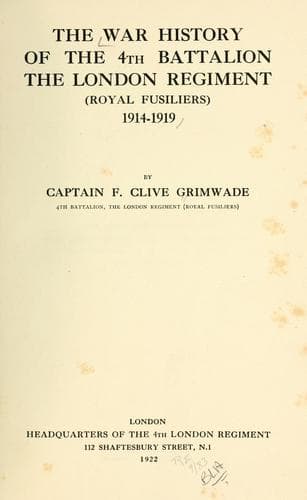
The War History of the 4th Battalion, the London Regiment (Royal Fusiliers), 1914-1919Grimwade, F. Clive
History
The War History of the 4th Battalion, the London Regiment (Royal Fusiliers), 1914-1919
Grimwade, F. Clive
Great Britain. Army. London Regiment. 4th (City of London) Battalion; World War, 1914-1918 -- Regimental histories -- Great Britain
This week of continual working parties was most exhausting to all
concerned. The distance to be covered each night to and from the scene
of the work was about three and a half miles in each direction, and the
labour of the march was increased tenfold by the shocking condition of
the ground, which was still waterlogged, and, away from the defined
tracks, nothing but a series of lakes formed by shell craters full of
water. Heavy as the cable line duties were found, the laying of the
duckboard track during the latter half of the week proved still more
onerous. Not only had the troops to march to St Julien from the Canal
Bank, but the duckboards which were drawn from a dump at Alberta Farm
had to be carried on the men's shoulders for some five hundred yards to
the starting-point of the track. Progress was slow through the heavy
going and the continual delays caused by German Véry lights. Although
some two hundred and forty yards were laid during the four nights'
work, and the track was carried forty yards beyond our most advanced
positions, the task was never completed. The work was obviously fraught
with considerable risk of serious casualties owing to the large numbers
of men employed, and in the circumstances the losses incurred during
the week were light; 11 men being hit on the 11th, while on the 15th
2/Lieut. Carlisle was killed and 2/Lieut. Pike wounded, with 2 men
killed and 5 wounded.
On the night of the 18th the 2/4th Londons relieved the 2/3rd Londons
in the line, which was still held by isolated posts, and the following
evening assembly for the attack began at about 9 p.m.
The 58th Division front of attack was entirely north of the Hanebeek,
a small stream which runs almost due east from St Julien, the attack
south of the stream being undertaken by the 164th Brigade of the 55th
Division. The 58th Divisional front was taken up by the 173rd Brigade
on the right with the 174th on its left, the assaulting columns of
the 173rd Brigade consisting of four companies, each 100 strong, of
the 2/4th Londons. The 2/3rd Londons were in reserve to make a dummy
attack, with one company on the waterlogged portions of the front over
which no advance was possible.
Public-domain text, read in full here on John Shaqi.
Reviews
Reviews
No reviews yet
Be the first to share your thoughts on this work.
Elsewhere in the archive
Join the Discussion
Join the discussion
Sign in to leave a comment or review.
Sign InorCreate an account