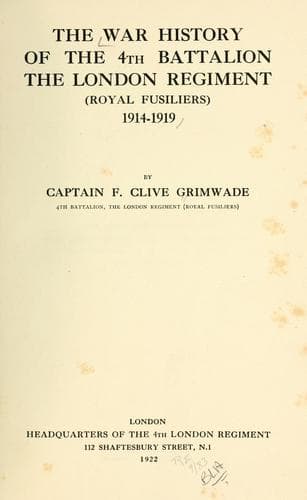
The War History of the 4th Battalion, the London Regiment (Royal Fusiliers), 1914-1919Grimwade, F. Clive
History
The War History of the 4th Battalion, the London Regiment (Royal Fusiliers), 1914-1919
Grimwade, F. Clive
Great Britain. Army. London Regiment. 4th (City of London) Battalion; World War, 1914-1918 -- Regimental histories -- Great Britain
This new feature in the fighting called for prompt measures on the
part of the British, and henceforward no attempt was made as a rule
to penetrate the enemy's pillbox system as long as any risk existed
of leaving any of these hornets' nests undisposed of in rear of the
advancing troops. In other words, the attacks were arranged with
objectives much more limited than formerly, while the artillery paid
more attention to the pillboxes, the ultimate capture of which formed
the task of special units detailed for the purpose.
The assault arranged for the 20th September was prepared on these
revised lines, and all ranks were impressed beforehand with the
importance, not only of locating enemy strong points quickly and
rushing them before their occupants had recovered from the British
barrage, but also of methodical "mopping-up" and consolidation of all
ground gained.
From the 9th September onwards the work of preparation for the
impending offensive was pushed forward with all possible speed, the
2/4th Londons bearing a heavy share of these necessary duties. For four
of the five nights spent at Reigersburg Camp a working party of the
strength of two companies was engaged in completing the advanced cable
line trench, while on the last night, the 13th, the whole Battalion
less B Company (still at the Musketry Camp) was detailed for carrying
various sorts of R.E. material forward to advanced dumps in readiness
for consolidation of the position it was hoped to gain.
On the 14th the 2/4th Londons moved to a fresh position on the east
side of the Yser Canal, and for four nights following, the whole
Battalion was engaged in the desperate task of laying a duckboard track
of double width in front of St Julien, as far forward as possible in
the direction of the enemy positions, with the object of providing
a means of communication in the forward area, and of reinforcing or
relieving the advanced troops after the assault should have been
delivered.
Public-domain text, read in full here on John Shaqi.
Reviews
Reviews
No reviews yet
Be the first to share your thoughts on this work.
Elsewhere in the archive
Join the Discussion
Join the discussion
Sign in to leave a comment or review.
Sign InorCreate an account